
4-Way Stretch Fabric: Why Fightwear Brands Depend on It
A rash guard that rides up during a guard pass gets noticed fast, and so do fight shorts that pull tight on a high kick. In combat sports, clothing is pulled, gripped, twisted, and stretched in every direction, often within seconds. That’s why 4 way stretch fabric sits at the center of almost every serious fightwear line.
For brands launching rash guards, MMA shorts, or compression gear, understanding stretch is more than a technical detail. It decides how a product fits, how it survives training, and whether customers come back. This guide covers:
- what 4-way stretch means and how it compares with 2-way stretch
- where stretch comes from
- how to evaluate fabric before you approve a production run
What Is 4-Way Stretch Fabric?
4-way stretch fabric stretches and recovers both across its width and along its length. Every fabric has two main directions: crosswise (weft or courses) and lengthwise (warp or wales). A four way stretch fabric gives in both.
What Does 4-Way Stretch Mean?
The “four” refers to the directions you can pull: left, right, up, and down. A 4 way stretch material moves with the body whether an athlete is reaching overhead, bending deeply at the hips, or extending a leg. The amount of stretch doesn’t have to be identical in both directions, but it should be meaningful in each.
What Is 2-Way Stretch Fabric?
A 2 way stretch fabric, also called two way stretch fabric, stretches mainly in one direction, usually across the width. Its length stays relatively stable. That makes 2 way stretch material useful where some give is needed but the garment must hold its structure, such as stretch trousers, fitted T-shirts, or certain short panels.
4-Way Stretch vs. 2-Way Stretch Fabric
| Feature | 2-way stretch | 4-way stretch |
| Direction of stretch | Mainly across the width | Width and length |
| Fit | More structured | Follows the body closely |
| Typical fightwear use | Some short panels, casual training tees | Rash guards, compression, stretch panels in shorts |
| Main advantage | Stability and shape | Full range of motion |
| Main limitation | Restricts lengthwise movement | Needs good recovery to avoid bagging |
In the 2 way vs 4 way stretch fabric decision, neither is automatically better. The question is how much movement the garment has to allow, and in which direction.
For close-fitting fightwear, lengthwise stretch is usually essential. Without it, a rash guard rides up the torso and compression shorts creep down during scrambles.
Where Stretch Comes From
Elastane Fabric: What Is Spandex Fabric?
Spandex is an elastic synthetic fiber that can stretch many times its length and spring back. Three names describe the same type of fiber:
- Spandex is the common term in the USA and Canada.
- Elastane is used in Europe and much of the global industry.
- LYCRA is a trademarked brand of elastane fiber.
Elastane fabric is almost always a blend. Polyester, nylon, or cotton provide the fabric’s body, durability, and feel, while the spandex provides recovery. A 4 way stretch spandex fabric typically has elastane working in both directions. A 2 way stretch spandex fabric gets its elasticity mainly in one direction.
Mechanical Stretch Fabric
Mechanical stretch fabric gets its give from yarn and fabric construction rather than elastane. Textured or high-twist yarns and certain knit or weave structures let the fabric extend without spandex. Mechanical stretch can feel comfortable and is common in lightweight fight short fabrics, but its recovery is generally weaker than a well-made spandex blend’s.
Knits vs. Wovens
Knits are made of interlocking loops, so they stretch naturally, and most rash guards and compression garments are knits. Wovens interlace yarns at right angles and are naturally stable. A woven only becomes 4-way stretch when elastic yarn or mechanical stretch is engineered into both directions.
Stretch Fabric Types Used in Fightwear
| Fabric | Typical character | Common fightwear use |
| Polyester and spandex knit | Durable, colorfast, sublimation-friendly | Rash guards, compression shirts and shorts |
| Nylon-spandex knit | Soft, smooth, strong | Premium compression and spats |
| Polyester-spandex woven | Lightweight with 4-way give | MMA and grappling short panels |
| Mechanical stretch polyester | Light, quick-drying, moderate stretch | Fight shorts, training shorts |
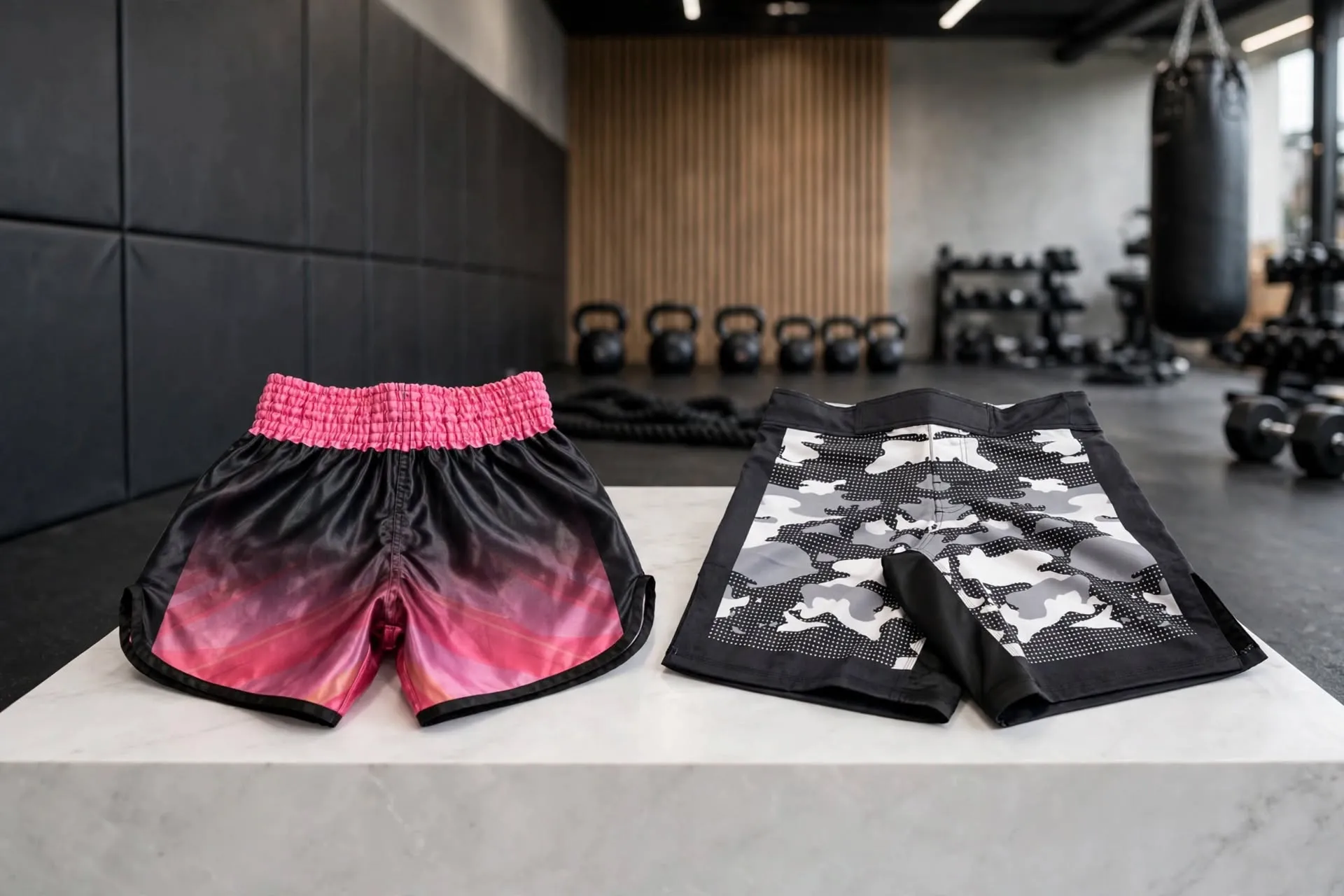
| Satin | Traditional sheen, minimal stretch | Muay Thai shorts (mobility comes from the cut, not the fabric) |
Polyester and Spandex Fabric: The Fightwear Workhorse
Polyester and spandex fabric dominates custom fightwear for a practical reason. It combines stretch and recovery with polyester’s low absorbency, durability, and compatibility with sublimation printing. That lets brands produce full-color, all-over designs on garments that move with the athlete.
Polyester’s moisture handling also matters on the mats; our guide to moisture-wicking fabric explains how it works.
Why Fightwear Brands Depend on 4-Way Stretch
Rash Guards and Compression
A rash guard sits close to the skin, so it has to stretch in every direction and return to shape after every roll. Good 4-way stretch helps it stay in place, resist riding up, and keep its fit across months of training. That’s why Deuka Wears’ rash guards and training sets use polyester-spandex blends.
Brands making ranked rash guards for competition should check the current uniform rules of the relevant organization, since requirements vary and change.
MMA and Grappling Shorts
Fight shorts need room for kicks, sprawls, and guard work without the bulk of a fully elastic garment. Many designs combine a lighter body fabric with 4-way stretch crotch panels and side slits, which puts mobility exactly where the body needs it. Our MMA and Muay Thai shorts use this kind of stretch-panel construction.
Muay Thai Shorts and Low-Stretch Fabrics
Traditional Muay Thai shorts often use satin, which has little stretch. Their mobility comes from a wide leg cut and high side splits instead. It’s a useful reminder that pattern design and fabric work together: a good cut can do some of the work stretch fabric does.
Stretch Is Only Half the Story: Recovery
Stretch gets the athlete into the garment, but recovery keeps it fitting. A fabric that stretches easily but doesn’t spring back will bag at the knees, sag at the waist, or loosen at the neck after a few sessions.
How Much Spandex Do You Need?
Spandex content is a useful guide, though not a guarantee. Commonly cited ranges are roughly:
- a few percent for comfort stretch
- around 5 to 10% for moderate stretch
- higher percentages for compression and close-fitting performance wear
Knit structure, yarn quality, and finishing can matter as much as the percentage. A higher number on the label doesn’t automatically mean better recovery.
Sublimation on 4-Way Stretch Spandex
Most custom rash guards and fight shorts are sublimated, and stretch fabrics raise two specific issues.
Grin-Through on Stretched Areas
Sublimation prints onto a white base fabric. When a dark or saturated design is stretched hard, small flecks of that white base can show between the stretched yarns, especially across the shoulders, elbows, and knees. Designers can reduce this by placing very dark solids carefully and reviewing a stretched sample before approving bulk production.
Heat and Elastane
Elastane is sensitive to heat, and sublimation uses heat and pressure, so press settings need to suit the fabric. Excess heat during production, or high dryer heat at home, can reduce recovery over time.
Our complete guide to sublimation printing for teams covers the process. Our guide to caring for sublimated apparel explains the washing habits that protect it.
How to Evaluate a Stretch Fabric Sample
A Simple Stretch Test
Measure Stretch Percentage
Mark two lines 4 inches (about 10 cm) apart on a relaxed swatch. Stretch it to firm resistance and measure the new distance. Stretch percentage is the increase divided by the original length, so stretching from 4 to 6 inches is 50%.
Repeat the test lengthwise. For true 4-way stretch, both directions should give meaningfully.
Check Recovery
Hold the stretch for a few seconds, release it, and measure again. The marks should return close to 4 inches without rippling. Visible waviness or lasting growth is a warning sign.
Test the Stress Zones
Repeat the test on a finished sample at the points that take the most strain: neckline, shoulders, waistband, crotch, and knees. Then wash the sample several times and test again.
Document the Approved Fabric
Once a fabric passes, record its composition, weight, construction, and color. Matching that specification on reorders keeps your products fitting the same way season after season.
For formal results, standards organizations such as ASTM publish stretch and recovery test methods. Ask your supplier what testing is available.
Building a Fightwear Line With Deuka Wears
Deuka Wears manufactures custom combat and MMA wear in Sialkot, Pakistan, for gyms, academies, and fightwear brands in the USA, Canada, and international markets.
If you’re starting out, our guide on how to start an MMA clothing brand walks through planning. Our MMA gear manufacturing guide covers everything from sampling to bulk production.
Brands developing their own collections can explore our private label services. Share your product type, fit, and design, ask about fabric options and samples, and request a quote when you’re ready.
Frequently Asked Questions
Is 4-way stretch better than 2-way stretch?
Not always. 4-way stretch is better for close-fitting garments that need full movement, like rash guards, while 2-way stretch can suit garments that need more structure.
Is spandex the same as elastane and Lycra?
Spandex and elastane are two names for the same fiber. LYCRA is a trademarked brand of elastane.
Does 4-way stretch fabric lose its stretch?
It can. High heat, chlorine, and repeated stress can weaken elastane over time. Washing in cool water and avoiding high dryer heat help preserve recovery.
Can 4-way stretch fabric be sublimated?
Yes. Polyester-spandex blends are widely sublimated. Press settings should suit the fabric, and stretched samples should be checked for the white base showing through.
Do fight shorts need to be fully 4-way stretch?
Not necessarily. Many fight shorts use stretch panels in key areas such as the crotch, combined with a lighter body fabric and side slits for mobility.
Final Thoughts: Choose Stretch With Purpose
4-way stretch fabric is the foundation of modern fightwear, but the label alone tells you little. What matters is the direction of stretch, how well the fabric recovers, how it handles sublimation and heat, and whether it suits the specific garment.
A rash guard, a pair of grappling shorts, and Muay Thai shorts all need movement, yet each gets it differently. Brands that test samples, match fabric to each garment’s real demands, and lock in their specifications build products that fit right on the first roll and still fit after the hundredth.
TOP RATED PRODUCTS
New posts

November 2, 2026
Print-Ready Artwork: File Formats Jersey Manufacturers Need

November 2, 2026
IBJJF Rash Guard Rules: Ranked Colors for Every BJJ Belt

November 2, 2026
Leather vs Synthetic Boxing Gloves: What Brands Should Pick

November 2, 2026
Clothing Manufacturers in Pakistan: Sportswear Buyer’s Guide

November 2, 2026
Lacrosse Jersey Numbers: Rules for Pinnies and Game Uniforms

November 2, 2026
4-Way Stretch Fabric: Why Fightwear Brands Depend on It

November 2, 2026
Moisture-Wicking Fabric: How It Works in Team Sportswear

November 2, 2026

Leave a comment