Clothing Manufacturers in Pakistan: Sportswear Buyer’s Guide
If you’re comparing clothing manufacturers in Pakistan, you’ve probably noticed that almost every website claims to make everything, for everyone, at the best price. That makes it hard to tell which factory actually fits your product. A team dealer sourcing sublimated jerseys, a brand developing compression wear, and a retailer buying cotton hoodies all need different capabilities, even if they end up in the same city.
This guide is for buyers in the USA, Canada, and other export markets who are considering sourcing sportswear from Pakistan. It covers:
- where Pakistan’s strengths lie
- how different types of manufacturers work
- what to check before you commit
- how to brief a factory so the quotes you receive are actually comparable
Why Buyers Look at Clothing Manufacturers in Pakistan
The Pakistan Textile Industry at a Glance
The Pakistan textile industry is one of the country’s largest export sectors. It spans cotton growing, spinning, knitting, weaving, dyeing, and garment production. That depth matters for buyers, because a manufacturer working inside an established supply chain can often source fabrics, trims, and services locally rather than depending entirely on imports.
Pakistan clothing manufacturers serve a wide range of categories, from cotton knitwear and denim to workwear, home textiles, and sportswear. That breadth is useful, but it also means you need to look past the country label and evaluate each factory on the products you actually need.
Sialkot: Pakistan’s Sports Manufacturing Hub
For sportswear, most searches lead to Sialkot. The city has long been known for sports goods exports, and Sialkot manufacturers cover everything from balls and gloves to team uniforms, fightwear, and activewear. Sialkot sportswear makers benefit from having fabric suppliers, printers, embroiderers, and trim suppliers close together, which can simplify both development and production.
Location alone doesn’t guarantee quality, though. Two factories on the same street can differ completely in equipment, quality systems, and product expertise.
Types of Apparel Manufacturers in Pakistan
Not every business that calls itself a manufacturer works the same way. Knowing the model helps you understand who controls quality and timing.
| Business type | What it typically does | What to confirm |
| Vertically integrated factory | Handles most steps in-house, from cutting and printing to sewing and packing | Which processes are genuinely in-house |
| Garment manufacturer (cut and sew) | Sews garments, often outsourcing fabric, printing, or embroidery | Who controls the outsourced steps |
| Textile manufacturer | Produces yarn or fabric rather than finished garments | Whether they sell finished goods at all |
| Trading or sourcing company | Places orders with partner factories | Which factory will make your order |
None of these models is automatically better. Textile manufacturers in Pakistan may be the right partner for a brand buying fabric, while garment manufacturers in Pakistan suit buyers who need finished products. What matters is knowing who is responsible for each step of your order.
How to Evaluate Sportswear Manufacturers in Pakistan
Product Specialization
Ask for examples of products close to yours. Sublimated team uniforms, compression garments, fleece hoodies, and fight shorts each need different fabrics, patterns, and sewing skills. Strength in one category doesn’t guarantee strength in another.
In-House Processes
For sportswear, decoration is often the deciding factor. Confirm whether sublimation printing, screen printing, and embroidery are done in-house or outsourced, and ask how color is kept consistent between batches. If you’re new to the process, our complete guide to sublimation printing for teams explains what to look for.
Sampling and Approval
A reliable clothing factory in Pakistan should have a clear sampling process. Ask how long samples take, what they cost, how revisions are handled, and how the approved sample becomes the reference for bulk production.
Quality Control
Ask what is checked and when: fabric before cutting, measurements during production, print and stitch quality, and a final inspection before packing. Written procedures and inspection records are more useful than general quality claims. For larger orders, you can also arrange an independent third-party inspection before shipment.
Communication and Time Zones
Pakistan Standard Time is UTC+5, roughly 9 to 10 hours ahead of US Eastern Time depending on daylight saving. That gap can work in your favor, because questions sent at the end of your day can be answered by your next morning. Agree on a main contact, a preferred channel such as email or WhatsApp, and how approvals will be documented.
Certifications and Compliance
Certification logos on a website are a starting point, not proof. If your market or customer requires specific standards, such as restricted-substance testing or social-compliance audits, ask for the actual certificate or report. Check:
- the company name and site address
- the scope and issuing body
- the expiry date
- whether it covers the products and processes in your order
Raise these requirements at the start, because they can affect fabric choices, cost, and timing.
Questions to Ask Before Placing an Order
- Do you currently manufacture this exact type of product?
- Which processes are in-house, and which are outsourced?
- What is the minimum order for this specification, per design and per color?
- What is the sampling process, cost, and timeline?
- How is color matched and kept consistent on reorders?
- What inspections happen during and after production?
- What are the payment terms and the shipping terms (Incoterms)?
- Who will be my contact once production starts?
MOQs, Pricing, and Lead Times
There is no single MOQ, price, or lead time for sportswear manufacturers in Pakistan. All three depend on fabric, decoration, construction, quantity, and the factory’s schedule. Ask how the minimum is calculated, whether sizes can be mixed, and what each quote includes. Compare quotes on the same specification first, then compare prices. Smaller brands should also ask whether a reduced first run or a sample set is possible before committing to full production. Our guide to how much custom jerseys cost explains the cost factors in detail.
For lead times, ask for a breakdown: sampling, approval, materials, production, inspection, and shipping. Then plan backward from the date the products need to be in your customers’ hands.
Shipping, Duties, and Labels for US and Canadian Buyers
Shipping Options
| Method | Best suited to | Trade-off |
| Courier | Samples and small orders | Highest cost per unit |
| Air freight | Mid-size orders | Balances speed and cost |
| Sea freight, typically through Karachi | Large orders | Lowest per-unit cost, longest transit |
Our global presence page outlines how Deuka Wears handles international shipping.
Duties and Trade Terms
Import duties and taxes depend on your country, the product classification, and current trade policy, which has changed frequently in recent years. Confirm rates with a customs broker before you finalize a budget. Agree on Incoterms, such as FOB or DDP, in writing so everyone knows who pays for what.
Labeling Requirements
The USA and Canada both have textile labeling rules covering fiber content, country of origin, and manufacturer identification. Confirm the current requirements for your products and approve label artwork before production.
Red Flags When Choosing a Clothing Factory
- The factory claims expertise in every product you mention.
- One quote is far below the others with no clear explanation.
- The supplier resists samples or written approvals.
- Quality control is described only as “excellent,” with no process behind it.
- The production location or subcontracting arrangement keeps changing.
- Basic questions take repeated follow-ups before you’ve paid a deposit.
A Practical Workflow for Sourcing From Pakistan
Prepare a Brief Before Contacting Factories
What to Include
Send every shortlisted manufacturer the same brief, covering:
- product type and reference images or a tech pack
- fabric and weight
- size range and quantities
- colors, branding, labels, and packaging
- destination and target delivery date
Sportswear-Specific Details
Add the decoration method, any performance requirements such as stretch or moisture management, and fit notes, such as whether jerseys must fit over pads.
Personalization Data for Team Orders
For team uniforms, include a roster with sizes, names, and numbers in one spreadsheet. Clear personalization data prevents the most common team-order errors.
Once the quotes arrive:
- Approve a physical sample.
- Confirm the specifications in writing.
- Start with a manageable first order.
- Keep the approved sample as the benchmark for reorders.
Sourcing From Pakistan With Deuka Wears
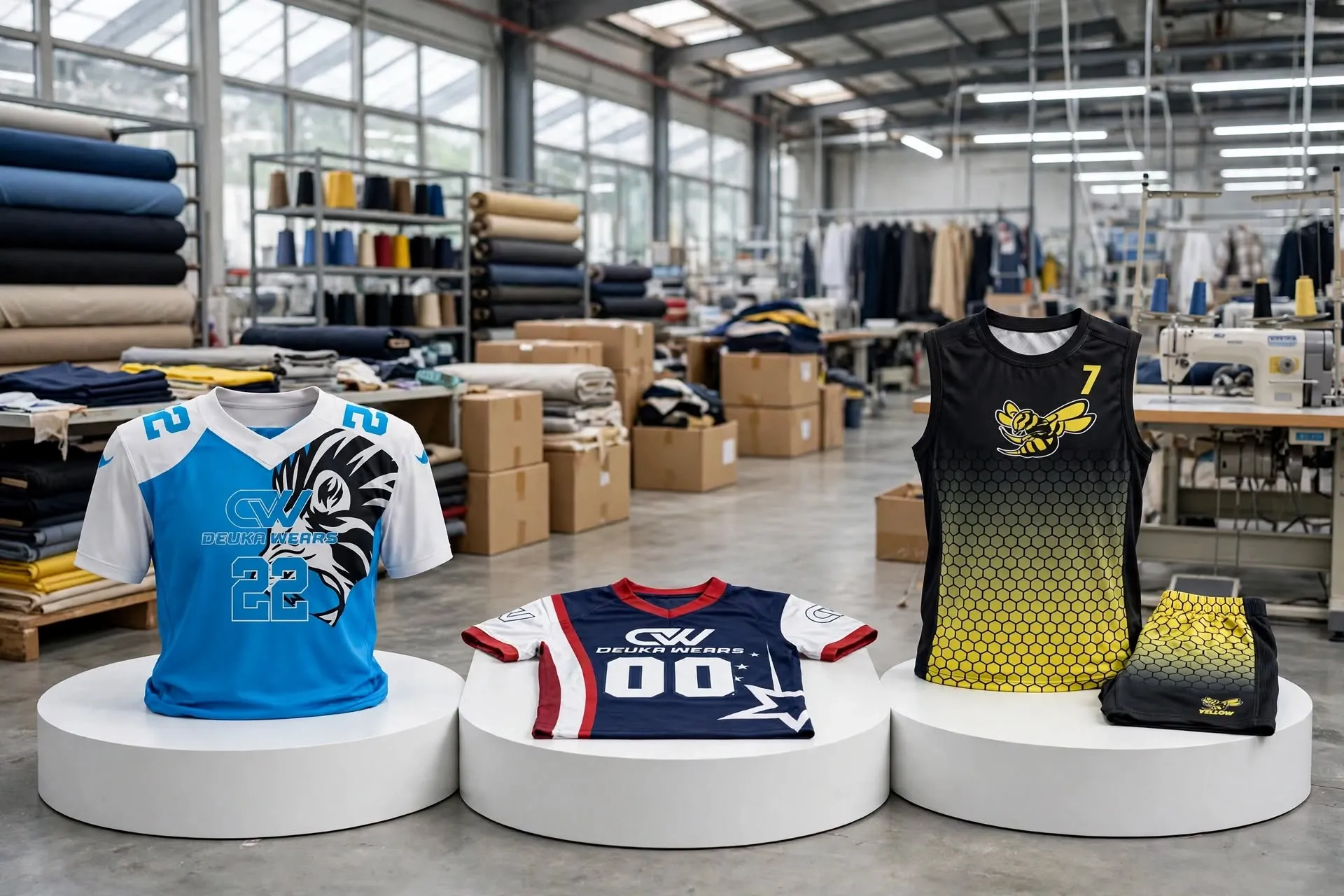
Deuka Wears is a factory-direct sportswear manufacturer in Sialkot, Pakistan. We produce custom team uniforms, sublimated sportswear, streetwear, and combat and MMA wear for buyers in the USA, Canada, and international markets.
We work with teams, clubs, distributors, and brands through wholesale and bulk ordering, private label services, and our custom sublimation and design service.
Send us your brief and ask the same questions you’d ask any supplier. When you’re ready, request a quote.
Frequently Asked Questions
Is Pakistan a good place to source sportswear?
For many buyers, yes. Pakistan has an established textile industry, and Sialkot is a long-standing sports manufacturing center. The right choice still depends on each factory’s product experience and quality systems.
Why is Sialkot known for sportswear?
Sialkot has a long history of producing sports goods for export. Its concentration of manufacturers, suppliers, and skilled workers supports sportswear production.
Can Pakistani manufacturers produce private label clothing?
Many can, including custom labels, tags, and packaging. Capabilities and minimums vary, so confirm what each factory handles in-house.
How do I verify a clothing manufacturer in Pakistan?
Request business details, product examples, and samples, and ask which processes are in-house. For larger orders, consider a factory visit or a third-party inspection.
What is the typical MOQ for apparel manufacturers in Pakistan?
There’s no standard MOQ. It depends on the product, fabric, colors, and decoration, so ask for the minimum against your exact specification.
Final Thoughts: Choose the Factory That Fits Your Product
Pakistan offers international buyers a deep textile supply chain and, in Sialkot, a long-established sportswear manufacturing base. But the country is only the starting point. The right manufacturer has proven experience with your product, controls the processes that matter, communicates clearly, and documents every approval.
Send every shortlisted supplier the same detailed brief, insist on samples, compare specifications before prices, and start with an order size that lets you build trust. That approach turns a long list of clothing manufacturers into one reliable partner.
TOP RATED PRODUCTS
New posts

November 2, 2026
Print-Ready Artwork: File Formats Jersey Manufacturers Need

November 2, 2026
IBJJF Rash Guard Rules: Ranked Colors for Every BJJ Belt

November 2, 2026
Leather vs Synthetic Boxing Gloves: What Brands Should Pick

November 2, 2026
Clothing Manufacturers in Pakistan: Sportswear Buyer’s Guide

November 2, 2026
Lacrosse Jersey Numbers: Rules for Pinnies and Game Uniforms

November 2, 2026
4-Way Stretch Fabric: Why Fightwear Brands Depend on It

November 2, 2026
Moisture-Wicking Fabric: How It Works in Team Sportswear

November 2, 2026

Leave a comment