
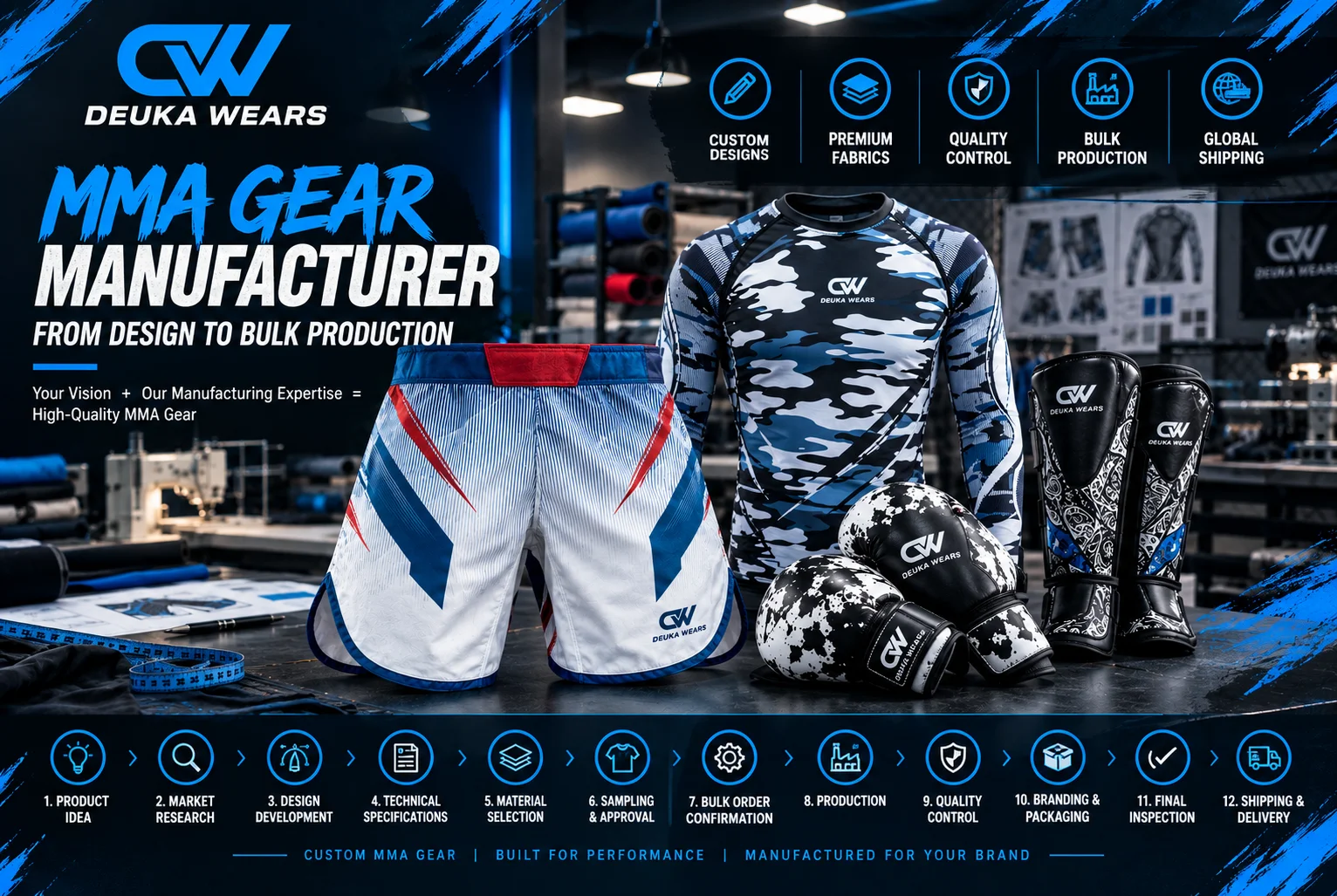
MMA Gear Manufacturer: From Design to Bulk Production
Launching an MMA product line involves more than creating an attractive design. Brands need the right materials, accurate specifications, reliable samples, quality control, suitable packaging, and a production partner that can handle bulk orders.
An experienced MMA gear manufacturer brings these stages together. From the first concept and technical specifications to sampling, production, inspection, and shipment, the manufacturing process determines the quality and consistency of your final products.
For MMA brands, retailers, distributors, gyms, and new fightwear businesses, understanding this process makes it easier to choose the right manufacturing partner and avoid expensive production mistakes.
This guide explains how MMA gear moves from an initial idea to finished bulk production.
What Does an MMA Gear Manufacturer Do?
An MMA gear manufacturer produces combat sports apparel and equipment according to a buyer’s requirements. Depending on the manufacturer’s capabilities, services can include product development, custom designs, material sourcing, sampling, branding, manufacturing, packaging, and export.
A manufacturer may work with businesses that need:
- Custom MMA apparel
- MMA fight shorts
- Rash guards and training sets
- Boxing gloves
- Shin guards
- Private label fightwear
- Wholesale MMA products
- Custom team gear
- Branded combat sports collections
The main advantage of working directly with a manufacturer is greater control over the product development process.
Instead of purchasing generic products and adding a logo later, a brand can develop products around its own design, specifications, branding, and target customers.
How MMA Gear Manufacturing Works
A professional manufacturing process normally moves through several stages:
- Product idea and market research
- Product design
- Technical specifications
- Material selection
- Prototype or sample development
- Sample approval
- Bulk order confirmation
- Production
- Quality control
- Branding and packaging
- Final inspection
- Shipping and delivery
Each stage has a purpose. Skipping one can create problems later in the process.
Step 1 — Start With the MMA Product Concept
Every successful product starts with a clear idea.
Before contacting an MMA gear manufacturer, determine what you want to produce and who will buy it.
For example, a new fightwear brand may want to launch:
- MMA fight shorts
- Rash guards
- Training sets
- Boxing gloves
- Shin guards
- Compression apparel
- Complete training collections
A retailer may need popular products in standard designs, while a private label brand may require completely customized products.
Define Your Target Customer
Your customer should influence the product from the beginning.
Consider whether you are targeting:
- Professional fighters
- Amateur athletes
- MMA gyms
- BJJ academies
- Fitness customers
- Fightwear enthusiasts
- Sports retailers
- Combat sports brands
Different customers can have different expectations for fit, durability, design, price, and performance.
Choose Your Initial Product Range
New brands do not always need a large collection.
Starting with a small group of complementary products can make production, inventory management, and marketing easier.
For example, a brand could launch with fight shorts and rash guards before expanding into additional combat sports products.
Deuka Wear provides a range of custom MMA and Muay Thai shorts for businesses developing their fightwear collections.
Step 2 — Turn Your Idea Into a Product Design
Once the product concept is clear, the next step is creating the design.
Your design should communicate your brand identity while also considering how the product will perform during training and competition.
For custom MMA apparel, design decisions can include:
- Colors
- Patterns
- Logos
- Sponsor placements
- Typography
- Panel construction
- Waistband design
- Hem details
- Stitching
- Print placement
- Size range
A strong design is not only visually appealing. It also needs to be practical for manufacturing.
Step 3 — Prepare Technical Specifications
A manufacturer needs more than an image of the product.
Technical information helps the factory understand exactly what needs to be produced.
A technical specification or tech pack can include:
- Product measurements
- Fabric composition
- Fabric weight
- Size specifications
- Stitching requirements
- Logo dimensions
- Print locations
- Label requirements
- Color references
- Packaging instructions
- Construction details
Why Tech Packs Matter
A clear tech pack reduces misunderstandings between the buyer and manufacturer.
For example, simply saying that you want “premium MMA shorts” does not tell a factory what fabric, measurements, waistband construction, print method, or stitching specifications you expect.
Detailed instructions create a much clearer production target.
Keep Specifications Consistent
If the same product will be manufactured repeatedly, your specifications should remain documented.
This allows future production runs to follow the approved version instead of relying on memory or informal instructions.
Document Every Approved Change
If a sample is modified, record the change before bulk production.
Small changes to measurements, materials, branding, or construction can affect the final product. Keeping an approved specification helps prevent unnecessary differences between samples and production.
Step 4 — Select the Right Materials
Material selection has a direct impact on comfort, durability, appearance, and product performance.
MMA apparel may require materials that can handle stretching, movement, sweat, and repeated training.
Depending on the product, manufacturers may work with materials such as:
- Polyester
- Spandex blends
- Poly-spandex fabrics
- Performance fabrics
- Satin materials
- Compression fabrics
The appropriate material depends on the product’s intended use.
For example, training apparel may require flexibility and moisture management, while fight shorts may require a different combination of durability, movement, and construction.
An experienced MMA gear manufacturer can help buyers understand which materials are appropriate for a particular product.
Step 5 — Develop the First Sample
Before placing a large production order, brands should normally review a sample.
The sample gives the buyer an opportunity to evaluate the physical product rather than relying only on digital designs.
Check areas such as:
- Overall fit
- Measurements
- Fabric feel
- Stretch
- Stitching
- Print quality
- Logo placement
- Waistband construction
- Seams
- Labels
- General finishing
Why Sampling Is Important
A sample can reveal problems that are difficult to identify from artwork alone.
For example, a logo may appear correctly positioned in a design file but look too high or low on the finished garment.
Similarly, a fabric may look suitable in a specification but feel different when worn.
Sampling allows these issues to be identified before bulk production.
Step 6 — Review and Approve the Sample
Sample approval is an important checkpoint.
The buyer should compare the physical sample with the original requirements and identify any changes.
Possible adjustments may include:
- Changing measurements
- Adjusting the fit
- Modifying fabric
- Moving logos
- Changing colors
- Improving stitching
- Revising labels
- Updating packaging
Once the sample meets the agreed requirements, the approved version can become the reference for bulk manufacturing.
Step 7 — Confirm Your Bulk Order
After sample approval, the manufacturer can prepare for bulk production.
Before production begins, both sides should confirm the important order details.
These may include:
- Product styles
- Quantities
- Size breakdown
- Colors
- Material
- Branding
- Packaging
- Production specifications
- Delivery requirements
- Shipping arrangements
Understand MOQ
MOQ means Minimum Order Quantity.
Manufacturers may establish MOQs because bulk production requires materials, labor, machine setup, printing, packaging, and other resources.
For new brands, MOQ is an important consideration because ordering too much inventory can tie up cash flow.
A good manufacturing discussion should therefore cover both product requirements and realistic order quantities.
Step 8 — Begin MMA Gear Bulk Production
Once specifications and quantities are approved, manufacturing begins.
The exact production process depends on the product.
For apparel, it can include:
- Fabric preparation
- Cutting
- Printing or sublimation
- Sewing
- Label application
- Finishing
- Inspection
- Packing
For protective equipment, the construction process can involve different materials and specialized production stages.
The goal is consistency: every unit in the bulk order should match the approved specifications.
Step 9 — Branding and Customization
Branding is a major part of private label and custom MMA manufacturing.
A manufacturer may help businesses add branding elements such as:
- Woven labels
- Printed labels
- Logos
- Custom artwork
- Sublimation designs
- Hangtags
- Packaging
- Brand-specific color schemes
This allows businesses to create products that look like part of a complete brand rather than generic wholesale merchandise.
For brands that want to develop a broader collection, Deuka Wear also offers custom rash guards and training sets for combat sports and performance apparel.
Step 10 — Quality Control During Production
Quality control should not be treated as a final step only.
A reliable manufacturer should maintain quality throughout production.
Important checkpoints can include:
Material Inspection
Materials should be checked before they enter production to reduce the risk of problems appearing in finished goods.
Production Inspection
During manufacturing, products can be checked for issues such as:
- Incorrect stitching
- Uneven seams
- Printing problems
- Measurement differences
- Damaged materials
- Incorrect branding
Final Inspection
Finished products should be reviewed before packing and shipment.
The final inspection can verify whether the order matches the approved specifications and quantity.
Step 11 — Packaging Your MMA Gear
Packaging is another important part of the manufacturing process.
For retailers and brands, packaging can affect both presentation and inventory handling.
Depending on the order, packaging may include:
- Individual poly bags
- Size labels
- Product labels
- Hangtags
- Cartons
- Custom brand packaging
If products are being sold under a private label, packaging should be planned early rather than added at the last minute.
Step 12 — Prepare for International Shipping
Many MMA brands source products internationally.
This makes logistics an important part of the bulk production process.
Before shipment, buyers should understand:
- Production lead time
- Packaging requirements
- Shipping method
- Carton quantities
- Product documentation
- Destination requirements
- Estimated delivery schedule
An experienced export-oriented manufacturer can make communication and coordination easier for international B2B buyers.
What to Look for in an MMA Gear Manufacturer
Choosing the right factory can have a long-term impact on your brand.
Do not select a supplier based only on the lowest quoted price.
Consider the manufacturer’s:
- Product expertise
- Manufacturing capabilities
- Material options
- Customization services
- Sampling process
- Quality control
- MOQ flexibility
- Communication
- Production capacity
- Packaging options
- Export experience
Manufacturer vs. Trading Company
A trading company may source products from different factories, while a manufacturer produces products through its own manufacturing operation or controlled production facilities.
For brands that require detailed customization, direct communication with a manufacturing partner can provide greater visibility into product development and production.
Ask About Custom Manufacturing
If your goal is to build a recognizable fightwear brand, ask whether the supplier provides custom manufacturing rather than only ready-made products.
Questions can include:
- Can you manufacture from our designs?
- Do you provide samples?
- What is your MOQ?
- Which fabrics are available?
- Can you add private labeling?
- What quality checks are performed?
- Can you handle repeat bulk orders?
- Do you export internationally?
Why Work With a Professional MMA Gear Manufacturer?
A professional manufacturing partner can help turn an idea into a repeatable product.
For brands, this can mean better control over:
- Product specifications
- Quality
- Branding
- Materials
- Production quantities
- Packaging
- Future reorders
It can also make it easier to expand a successful product into a wider collection.
For example, a brand that starts with apparel may later add gloves, shin guards, or additional training products.
Deuka Wear provides custom boxing gloves and shin guards for businesses looking to expand their combat sports product range.
Common MMA Manufacturing Mistakes to Avoid
New brands can make avoidable mistakes when ordering their first products.
Choosing Price Over Quality
The lowest quote is not always the lowest overall cost.
Poor-quality products can lead to returns, complaints, damaged brand reputation, and lost customers.
Skipping the Sample
Ordering directly into bulk production without reviewing a sample can increase the risk of costly mistakes.
Providing Incomplete Specifications
A vague design brief can lead to different interpretations between the buyer and factory.
Ordering Too Much Inventory
Large quantities may reduce unit costs, but excess inventory can create cash-flow problems.
Ignoring Packaging
Packaging should be considered part of the product experience, especially for private label brands.
How Deuka Wear Supports MMA Gear Manufacturing
Deuka Wear works with businesses looking for custom and wholesale combat sports manufacturing.
Its manufacturing approach can support brands, wholesalers, retailers, distributors, gyms, and other B2B buyers developing combat sports products.
From product concepts and customization to bulk production, the objective is to help businesses create consistent fightwear collections for international markets.
For businesses exploring a complete range, the Custom Combat and MMA Wear collection provides a starting point for developing a broader product line.
MMA Gear Manufacturing Checklist
Before placing your first bulk order, review this checklist:
- Define your target customer
- Select your initial products
- Prepare product designs
- Create technical specifications
- Select appropriate materials
- Request samples
- Review sample quality
- Confirm measurements
- Approve branding
- Confirm MOQ
- Finalize quantities
- Approve packaging
- Confirm quality standards
- Discuss production lead time
- Plan shipping
- Approve the final production version
Following these steps can reduce uncertainty and make communication with your manufacturer much easier.
Frequently Asked Questions
What does an MMA gear manufacturer produce?
An MMA gear manufacturer can produce combat sports apparel and equipment such as fight shorts, rash guards, gloves, shin guards, training apparel, and other custom fightwear products.
Can an MMA gear manufacturer make products from my own designs?
Yes. Manufacturers that provide custom or OEM services can develop products based on customer designs, specifications, branding, and material requirements.
Do I need a sample before placing a bulk order?
A sample is strongly recommended for custom products. It allows you to check the fit, materials, construction, branding, and overall quality before committing to bulk production.
What is the difference between wholesale and custom MMA gear?
Wholesale products may use existing designs and specifications, while custom MMA gear is developed around a buyer’s specific requirements.
Can new MMA brands work directly with manufacturers?
Yes. Many manufacturers work with new brands as well as established retailers, distributors, gyms, and fightwear companies. The available MOQ and development process can vary by supplier.
How long does MMA gear manufacturing take?
Production time depends on the product, order quantity, customization requirements, sampling, materials, and factory schedule. Buyers should confirm the expected lead time before placing an order.
Final Thoughts
Choosing the right MMA Gear Manufacturer is about more than finding someone who can produce a product.
The right partner should understand design development, materials, customization, sampling, quality control, bulk production, packaging, and international fulfillment.
For an MMA brand, the manufacturing process starts with an idea but ends with a product that customers can trust.
By defining your specifications carefully, approving samples, confirming production details, and working with an experienced manufacturing partner, you can build a more consistent product line and create a stronger foundation for long-term growth.
Whether you are launching your first fightwear collection or expanding an established MMA business, a structured manufacturing process can help turn your product ideas into market-ready gear.

Leave a comment