
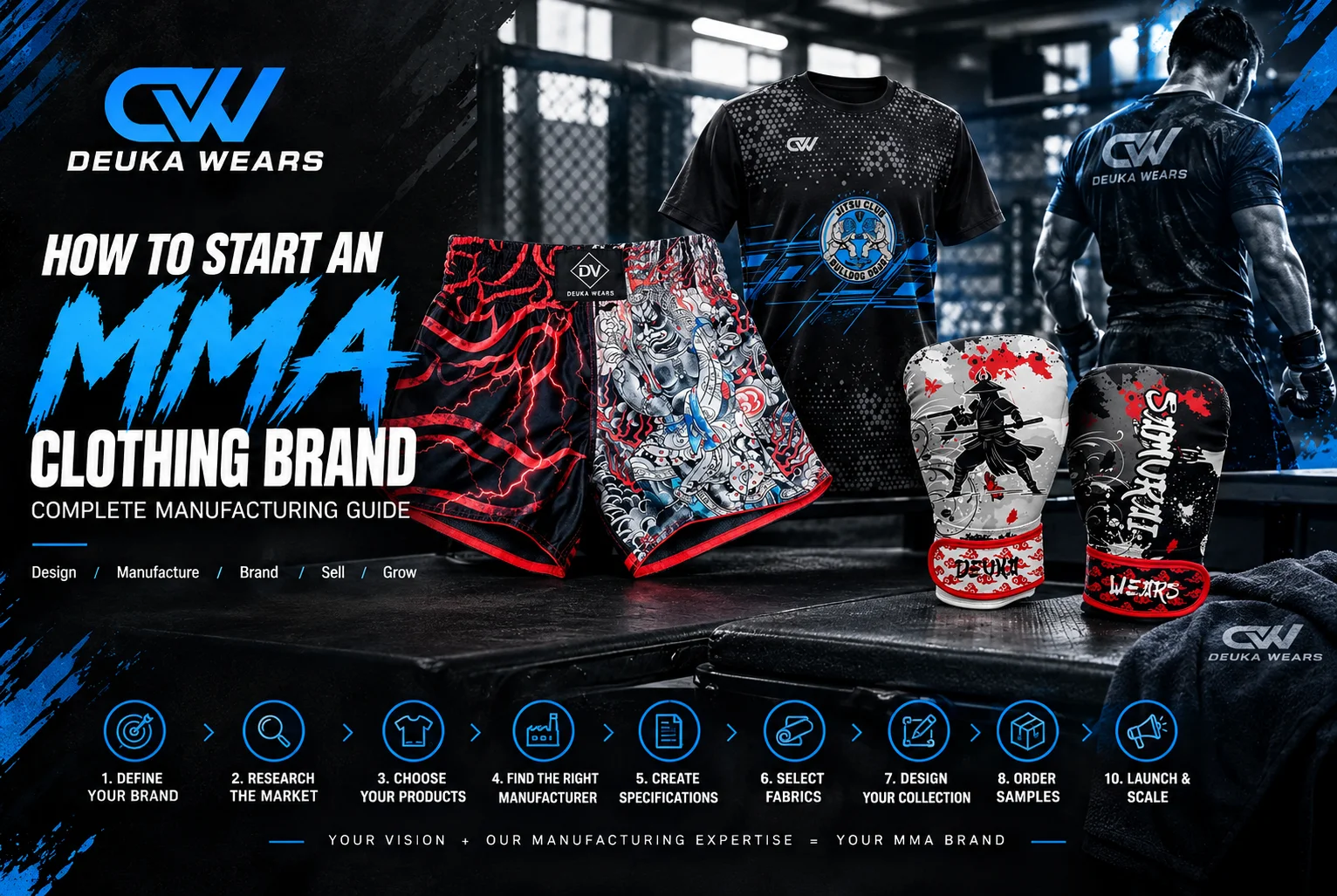
How to Start an MMA Clothing Brand: Complete Manufacturing Guide
Starting an MMA clothing brand can be an exciting business opportunity, but building a successful brand requires more than creating a logo and putting it on a pair of fight shorts.
You need to understand your customers, select the right products, develop a strong brand identity, find a reliable manufacturer, create product specifications, approve samples, plan production, and build a sales strategy.
Whether you want to create your own clothing brand from scratch, expand an existing sportswear business, or launch a dedicated fightwear collection, the manufacturing process plays a major role in your long-term success.
For new and growing brands, Deuka Wear provides custom sportswear manufacturing support for international B2B buyers looking to develop branded combat sports apparel.
This guide explains how to start an MMA clothing brand step by step, from choosing your niche to placing your first production order.
1. Define Your MMA Clothing Brand Before Manufacturing
Before contacting a manufacturer, decide exactly what your business will represent.
The MMA market includes athletes, gyms, fight teams, coaches, martial arts academies, retailers, online shoppers, and dedicated fightwear communities. Your brand should have a clear reason for serving a particular group.
Choose Your Target Customer
Your first customers could include:
- MMA fighters
- Amateur athletes
- Professional fighters
- MMA gyms
- BJJ academies
- Muay Thai gyms
- Fitness communities
- Fight teams
- Retail stores
- Online sportswear buyers
You can also target a specific demographic or training style.
For example, your collection could focus on performance apparel for competitive fighters, lifestyle clothing for MMA fans, or training gear for everyday gym users.
Decide What Your Brand Will Stand For
Successful MMA apparel brands usually have a recognizable identity.
Think about:
- Brand name
- Logo
- Color palette
- Typography
- Product style
- Price positioning
- Customer profile
- Brand story
- Performance promise
Your products should look connected across the collection rather than appearing like unrelated items.
2. Research Existing MMA Clothing Brands
Before creating your own collection, study the market.
Look at established MMA clothing brands and smaller emerging labels. Your goal is not to copy them. Instead, identify opportunities they are not serving well.
Study Products and Price Points
Compare:
- Fight shorts
- Rash guards
- Training tops
- Compression apparel
- Women’s products
- Gym clothing
- Protective gear
- Lifestyle apparel
Then compare their pricing, materials, designs, branding, packaging, and customer reviews.
This can help you identify where your own product line can compete.
Look for Gaps in the Market
You might discover opportunities such as:
- Better women’s MMA clothes
- More inclusive sizing
- Premium fightwear
- Affordable training apparel
- Custom gym collections
- Minimalist MMA designs
- High-performance compression wear
- Private-label fightwear
A clear market gap gives your new brand a stronger starting point.
3. Choose the Right Products for Your First Collection
One common mistake when starting a clothing brand is trying to launch too many products at once.
A better approach is to build a focused first collection around a few strong products.
Start With Hero Products
For an MMA clothing brand, potential hero products include:
- MMA fight shorts
- Muay Thai shorts
- Rash guards
- Training sets
- Compression tops
- Spats
- Gym shorts
- Performance shirts
You do not need ten or twenty products on day one.
Start with products that represent your brand well and can be developed to a high standard.
Build Around a Product Family
For example, one collection could include:
Fight shorts + rash guard + compression shorts
Another could include:
Training shirt + gym shorts + women’s performance top
This creates a complete look and gives customers more reasons to purchase from the same brand.
For brands developing fight shorts, Deuka Wear’s Custom MMA and Muay Thai Shorts can be used as part of a broader custom combat collection.
4. Decide Between Ready-Made, Private Label and Custom Manufacturing
Understanding manufacturing models is important when you create your own clothing brand.
Ready-Made Products
Ready-made products already exist and usually require limited customization.
This can be easier for beginners but provides less control over product design and differentiation.
Private Label Manufacturing
Private label allows you to sell a manufacturer’s product under your own brand with customized branding, labels, packaging, and selected specifications.
It can be a practical option for entrepreneurs who want to enter the market without developing every product from zero.
Custom Manufacturing
Custom manufacturing gives you more control over:
- Fit
- Fabric
- Colors
- Construction
- Graphics
- Branding
- Measurements
- Labels
- Packaging
This approach is especially useful when you want to build a distinctive product rather than sell a generic item.
5. Find a Manufacturer for Your Clothing Brand
Choosing the right manufacturer for your clothing brand can determine your product quality, costs, production timeline, and ability to scale.
Do not select a factory based only on the lowest quotation.
Check Manufacturing Experience
Look for a supplier that understands performance sportswear and combat apparel.
Ask about its experience with:
- MMA apparel
- Fightwear
- Compression clothing
- Sublimation
- Performance fabrics
- Custom sportswear
- Bulk production
- Private labeling
A manufacturer that understands the technical requirements of sportswear can provide better guidance during development.
Evaluate Production Capabilities
Before placing an order, ask whether the manufacturer can handle your complete requirements.
This may include:
- Fabric sourcing
- Pattern development
- Cutting
- Sewing
- Sublimation
- Embroidery
- Labels
- Packaging
- Quality control
- Bulk production
- Export shipping
An integrated production process can make communication and quality management easier.
6. Create Your Product Specifications and Tech Pack
A tech pack is essentially the blueprint for your garment.
It tells the manufacturer exactly how the product should be made.
What Should a Tech Pack Include?
Depending on the product, include:
- Front and back drawings
- Measurements
- Size chart
- Fabric composition
- Fabric weight
- Stitching requirements
- Color references
- Logo placement
- Print specifications
- Label details
- Packaging instructions
The more precise your specifications are, the less room there is for misunderstanding.
Why Product Specifications Matter
Imagine you send a manufacturer only a logo and a rough image.
The factory may understand the general appearance but still have questions about:
- Fit
- Fabric
- Length
- Stitching
- Waistband
- Printing
- Label placement
A detailed specification sheet removes much of this uncertainty.
Keep Your Brand Standards Consistent
Create a central document containing approved colors, logo files, fonts, size charts, labels, and product measurements.
This becomes your reference when you develop future products.
Record Every Approved Change
When a sample is revised, record what changed.
For example:
- Waistband adjusted
- Sleeve length changed
- Fabric changed
- Logo moved
- Size measurement updated
This prevents old specifications from accidentally being used during future production.
7. Select Fabrics for Performance and Comfort
MMA apparel needs to perform under movement, sweat, stretching, and repeated washing.
The fabric should match the purpose of the garment.
Fabrics for Compression Apparel
Rash guards and similar products often require fabrics with:
- Four-way stretch
- Good recovery
- Moisture management
- Durability
- Smooth hand feel
- Suitable print performance
For custom compression products, fabric selection should be discussed with the manufacturer before sampling.
Fabrics for Fight Shorts
Fight shorts need freedom of movement and durability.
Important characteristics can include:
- Lightweight construction
- Stretch
- Quick drying
- Secure waistband
- Strong seams
- Flexible side construction
For brands developing a complete collection, Deuka Wear also offers Custom Rash Guards and Training Sets, allowing apparel products to be developed as coordinated training collections.
8. Design Custom MMA Apparel
Design is where your brand becomes visible.
Custom MMA apparel can use different combinations of colors, graphics, logos, patterns, and branding techniques.
Build a Recognizable Design Language
Your products should share visual elements.
For example, you could use:
- The same primary colors
- A consistent logo position
- Similar graphic patterns
- Matching labels
- Consistent typography
This makes the collection look professional.
Use Sublimation for Detailed Designs
Sublimation is particularly useful for performance apparel where you want detailed graphics and full-color artwork.
It can be used for:
- Fight shorts
- Rash guards
- Training tops
- Compression garments
The artwork can cover large areas of the garment without adding a heavy surface layer.
9. Do Not Forget Women’s MMA Apparel
Women’s sportswear should not simply be a smaller version of men’s products.
If you want to target female athletes, develop products around their specific fit and requirements.
Consider Women’s MMA Clothes as a Separate Product Opportunity
Potential products include:
- Women’s rash guards
- Compression tops
- Performance shorts
- Training sets
- Sports bras
- Women’s gym apparel
Pay attention to:
- Body proportions
- Fit
- Length
- Support
- Fabric stretch
- Comfort
- Size grading
A dedicated women’s collection can help your brand reach an audience that is often underserved by generic combat apparel.
10. Order Samples Before Bulk Production
One of the most important rules when launching a clothing brand is:
Do not move directly from design to large-scale production.
Order a sample first.
What to Check During Sampling
Review:
- Overall fit
- Measurements
- Fabric
- Stitching
- Print quality
- Logo placement
- Color accuracy
- Comfort
- Stretch
- Finishing
- Labels
If possible, have real athletes test performance products during normal training.
Make Revisions Before Approval
A sample is not necessarily the final product.
You may discover that:
- The waistband is too tight
- The body length needs adjustment
- The fabric needs more stretch
- The print is too large
- The logo needs repositioning
Send clear feedback and request another sample when necessary.
11. Set Your MOQ and First Production Quantity
MOQ means minimum order quantity.
Your manufacturer may have different minimums depending on:
- Product type
- Fabric
- Custom design
- Printing
- Size range
- Labels
- Packaging
Start Small, Then Scale
New businesses should avoid buying more inventory than they can realistically sell.
Your first production run should give you enough stock to test the market while limiting unnecessary inventory risk.
Once certain products prove successful, increase production for the next order.
Plan Your Size Breakdown
Do not automatically order equal quantities of every size.
Use your target market and customer research to estimate demand.
As your sales history grows, your future production orders can become more accurate.
12. Build Your Brand Packaging
Your brand experience does not end with the garment.
Packaging can make a product feel more professional and memorable.
Consider:
- Branded poly bags
- Hang tags
- Woven labels
- Care labels
- Product cards
- Custom boxes
- Shipping packaging
Packaging should match the positioning of your clothing line.
A premium product should have packaging that supports the same quality perception.
13. Calculate Your Real Product Cost
Do not calculate your selling price using manufacturing cost alone.
Your actual product cost can include:
- Manufacturing
- Sampling
- Labels
- Packaging
- Freight
- Import duties
- Warehousing
- Payment fees
- Marketing
- Returns
- Website costs
Calculate Landed Cost
For international brands, landed cost is particularly important.
A product may look inexpensive at the factory level but become significantly more expensive after shipping, customs, duties, and other expenses.
Understanding your total cost before production helps you set a sustainable retail price.
14. Create Your Sales Strategy Before Launching
Manufacturing the products is only one part of launching a clothing brand.
You also need to decide how customers will discover and buy them.
Direct-to-Consumer
You can sell through your own website and use:
- SEO
- Social media
- Email marketing
- Paid advertising
- Athlete partnerships
- Content marketing
Gym and Academy Partnerships
MMA gyms and academies can become valuable customers.
You can offer:
- Team apparel
- Custom gym collections
- Member merchandise
- Coach apparel
- Training sets
Wholesale and Retail
As your brand grows, you can approach retailers and distributors.
This can provide larger purchase quantities and expand your reach into new markets.
15. Launch Your MMA Clothing Brand
Once your samples are approved and inventory is ready, prepare your launch carefully.
Build Product Pages
Every product page should explain:
- Product purpose
- Materials
- Fit
- Available sizes
- Features
- Care instructions
- Brand story
Use high-quality product photography showing the front, back, side, and important construction details.
Use Real Athletes
MMA apparel is performance-focused.
Photos and videos of real athletes training in your products can demonstrate:
- Fit
- Movement
- Comfort
- Design
- Durability
This can be more persuasive than product images alone.
16. Scale Your Clothing Brand After Launch
Once your first products start selling, use real customer data to guide expansion.
Do not add products simply because competitors have them.
Instead, analyze:
- Best-selling products
- Popular sizes
- Popular colors
- Customer feedback
- Repeat orders
- Return reasons
- Product reviews
Then use those insights to develop your next collection.
Expand Around Your Best Sellers
If a rash guard becomes a strong seller, you could introduce matching shorts or compression products.
If fight shorts perform well, you could create new designs, colorways, and coordinated training pieces.
For businesses looking to add protective products to their collection, Deuka Wear’s Custom Boxing Gloves and Shin Guards can complement an apparel-focused range.
Common Mistakes When Starting an MMA Clothing Brand
New entrepreneurs can avoid many problems by planning ahead.
Launching Too Many Products
A huge first collection increases inventory risk and makes quality control more difficult.
Choosing a Manufacturer Only on Price
The cheapest quotation may not provide the best quality or long-term value.
Skipping the Sample Stage
Bulk production without a properly approved sample can create expensive problems.
Ignoring Fit
A great graphic cannot save a poorly fitting garment.
Underestimating Shipping Costs
International freight and import expenses should be considered before setting retail prices.
Existing MMA Brands
Your brand needs a reason to exist.
Study competitors, but build your own identity, product strategy, and customer experience.
How Deuka Wear Can Support Your MMA Clothing Brand
Starting your own clothing line becomes easier when you work with a manufacturer that understands custom sportswear and combat apparel.
Deuka Wear provides custom manufacturing solutions for international B2B buyers, including brands, wholesalers, distributors, retailers, gyms, academies, and entrepreneurs.
Depending on the product, brands can develop custom:
- MMA and Muay Thai shorts
- Rash guards
- Training sets
- Boxing gloves
- Shin guards
- Combat apparel
- Performance sportswear
The manufacturing process can include design development, sampling, customization, bulk production, branding, and international shipping support.
For brands building a wider fightwear collection, explore the Deuka Wear Combat & MMA Wear collection.
Frequently Asked Questions
How much does it cost to start an MMA clothing brand?
The cost depends on your products, quantities, customization, sampling, packaging, shipping, marketing, and other business expenses. A focused first collection generally requires less capital than launching a large product range.
What products should I launch first?
MMA fight shorts, rash guards, training apparel, and compression products can be strong starting points because they fit naturally into a combat sports collection.
How do I find a manufacturer for my clothing brand?
Look for a manufacturer with relevant sportswear experience, clear communication, customization capabilities, sampling support, quality control, suitable MOQs, and international shipping experience.
Can I create my own MMA clothing brand with custom designs?
Yes. You can develop products around your own logo, colors, artwork, specifications, labels, and packaging through custom or private-label manufacturing.
Should I start with a small clothing collection?
For many new brands, starting with a focused collection can reduce inventory risk and make it easier to test customer demand before expanding.
Can I manufacture women’s MMA apparel?
Yes. Women’s MMA apparel can be developed with dedicated sizing, fit, fabrics, and product specifications rather than simply modifying men’s products.
What is the difference between private label and custom clothing?
Private label generally involves branding an existing or developed product under your own brand, while custom manufacturing gives you greater control over product specifications, design, materials, fit, and construction.
Is Pakistan a good manufacturing location for MMA apparel?
Pakistan, particularly Sialkot, has an established manufacturing ecosystem for sports goods and sportswear. For international brands, the important consideration is choosing a manufacturer with the right product expertise, quality systems, customization capabilities, and export experience.
Final Thoughts: Build Your MMA Brand Step by Step
Learning how to start an MMA clothing brand is only the beginning.
A successful fightwear business needs a clear audience, strong product concept, reliable manufacturing, accurate specifications, quality samples, sensible production quantities, professional branding, and a practical sales strategy.
You do not need to launch dozens of products immediately.
Start with a focused collection. Develop your hero products carefully. Test samples. Listen to athletes and customers. Improve your products. Then scale the designs and quantities that perform best.
Whether you are launching a clothing brand in the USA, Canada, UK, Europe, Australia, or another international market, choosing the right manufacturing partner can make the process more efficient and predictable.
With the right planning and a strong product foundation, your idea can move from a simple concept to a professional MMA apparel brand.

Leave a comment