
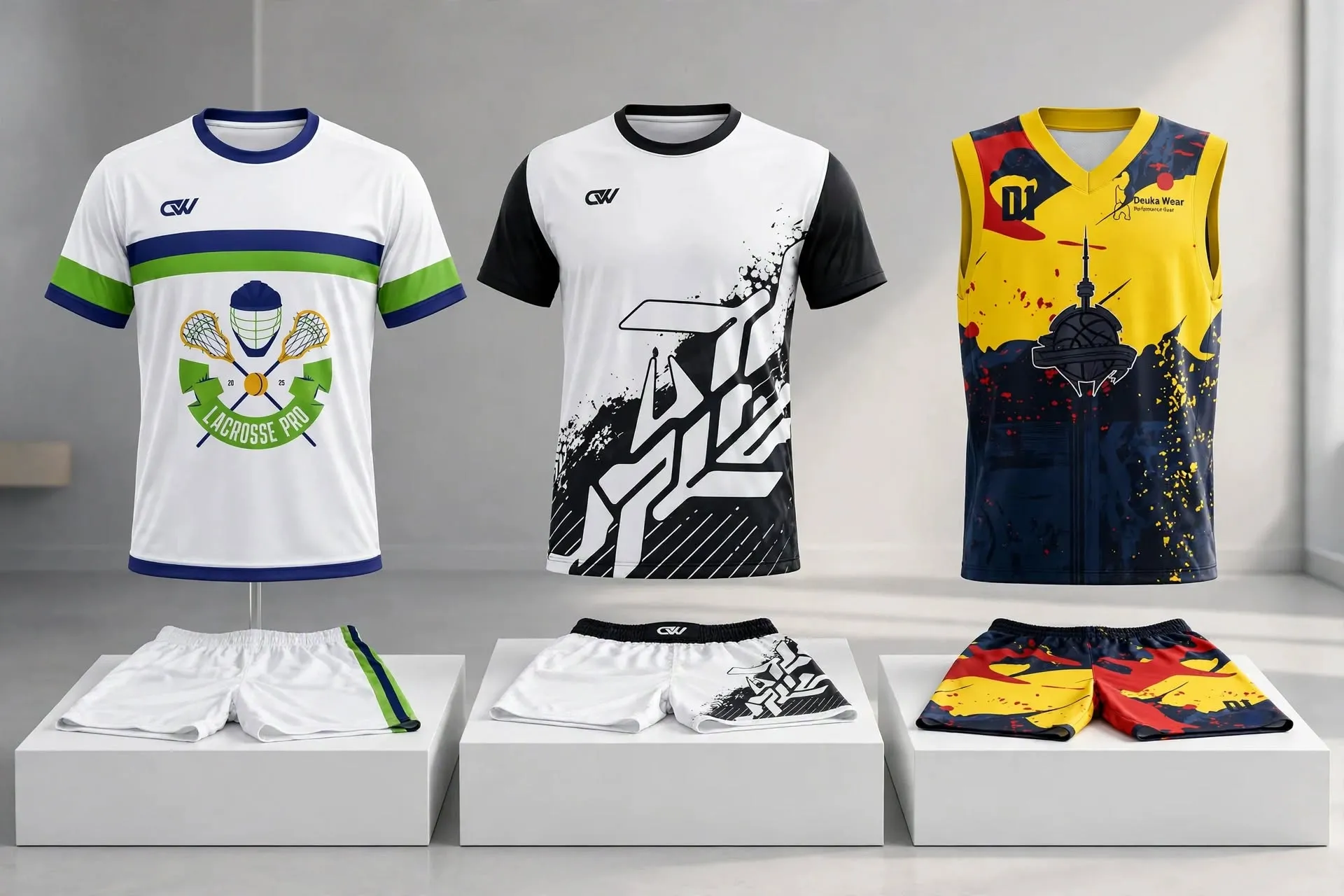
Lacrosse Jersey Numbers: Rules for Pinnies and Game Uniforms
Few things stall a lacrosse game faster than an official stopping play over a uniform. A number that’s too small, two players wearing the same digits, or a jersey color that clashes with the opponent can all become a game-day problem. Lacrosse jersey numbers look like a simple design detail, but they’re governed by rulebooks that differ by level, gender, and season.
This guide explains which rulebook applies to your team, what lacrosse jersey number rules typically cover, how pinnies fit in, and how to design numbers that pass inspection.
One important note before you start: uniform rules are updated regularly. Use this guide to plan, then confirm every requirement against the current rulebook or with your league before you approve a design.
Which Rulebook Sets Your Lacrosse Uniform Rules?
The rules of lacrosse aren’t one document. Each level of play follows its own book, and that book decides your uniform requirements.
| Level of play | Rulebook usually followed |
| Youth leagues (USA) | USA Lacrosse youth rules, or league-specific rules |
| High school boys (USA) | NFHS boys’ lacrosse rules, as adopted by each state association |
| High school girls (USA) | Girls’ high school lacrosse rules, adopted by state associations |
| College men’s and women’s (USA) | NCAA rules |
| Canadian programs | Provincial and national association rules |
| Box lacrosse | The rules of the specific box league |
Why the Rulebook Matters for Your Order
Two teams in the same town can face different requirements if one plays in a high school league and the other in a summer club circuit. Before you design anything, write the rulebook your team plays under at the top of the order. If a team plays under more than one book, such as club and high school, plan the uniform for the stricter one.
Lacrosse Jersey Number Rules: What Most Rulebooks Cover
Most lacrosse uniform rules address the same handful of number requirements, even when the exact figures differ.
Number Size and Placement
Rulebooks usually set a minimum number height for the front and back of the jersey, and require numbers to be centered. The table below shows minimums reported for the 2026 season. Treat them as a starting point to verify, not a final specification.
| Rulebook | Front number | Back number | Status |
| NFHS boys (high school) | At least 8 in (about 20 cm) | At least 8 in (about 20 cm); earlier editions required 12 in | Reported for 2026; verify |
| NCAA men’s | Reported as at least 10 in | Reported as at least 12 in | Verify with the current NCAA book |
| USA Lacrosse youth | Varies; check your league | Varies; check your league | League-dependent |
A jersey with numbers larger than the minimum generally stays legal. That’s why many programs simply build to the largest requirement they might face.
Contrast and Trim
Numbers must be clearly readable, which means they have to contrast with the jersey body. Rulebooks also commonly limit how wide a contrasting outline or trim around the number can be. A navy number on a black jersey might look sharp in a mockup and still fail on the field.
Legal Numbers and Duplicates
The major rulebooks don’t permit duplicate numbers on the same team. Many also define which numbers are legal, typically 0 to 99, and some restrict formats such as leading zeros. Lock the roster’s numbers before the design proof, so a duplicate is caught on paper rather than by an official.
NFHS Lacrosse Uniform Rules for High School Boys
High school boys’ programs in most states follow the NFHS rulebook. Beyond numbers, the NFHS lacrosse uniform rules typically cover several other details.
Jersey Color, Home and Away
NFHS rules call for jerseys of a single solid color, with the home team in white and the visiting team in a dark color. The visiting team is responsible for avoiding a color clash. That’s why most high school programs order both a white set and a dark set.
Shoulder Pads, Shorts, and Undergarments
The jersey must completely cover the shoulder pads, so it needs a cut that fits over them. All players on a team wear shorts of the same dominant color. Recent rule updates have also addressed the color of visible undershirts and compression shorts, so confirm the current wording and choose one under-layer color for the whole team.
Logos, Flags, and Patches
NFHS rules limit the size and number of manufacturer logos on each item. They also set size limits for an American flag and for memorial or commemorative patches, which may require state association approval. Side panels, collars, cuffs, and piping in contrasting colors have width limits too. Share these limits with your designer before the first mockup.
Lacrosse Rules for Men’s College and Club Play
Lacrosse rules for men’s college play follow the NCAA book, which has historically required larger numbers than high school rules. Men’s club teams, adult leagues, and summer tournaments often follow NFHS or NCAA uniform rules, or publish their own. If your club plays in several events, ask each organizer which book applies and size the numbers for the strictest one.
Women’s Lacrosse Uniform Rules
Girls’ and women’s lacrosse follow different rulebooks from boys’ and men’s, and the uniforms differ too. Women’s lacrosse uniform rules generally require:
- matching uniforms across teammates
- clearly visible numbers that contrast with the uniform
- bottoms such as kilts, skirts, skorts, or shorts, depending on the rulebook
Because the details vary by level, confirm number size, placement, and approved bottoms with the current girls’ high school or NCAA women’s rules. Our lacrosse uniforms guide for teams covers the practical differences between boys’ and girls’ uniforms, and options like women’s lacrosse skorts can be matched to your jersey design.
Numbers on Lacrosse Pinnies
Pinnies are lightweight, sleeveless tops worn over pads. Many teams use them for practice, tryouts, camps, and some game play. Our guide on what lacrosse pinnies are covers their uses and fit in detail.
Are Pinnies Legal Game Jerseys?
It depends on the rulebook and the league. Many youth and club programs use reversible lacrosse pinnies as game jerseys. Leagues with stricter jersey rules may require a standard game jersey instead, or allow a pinnie only if it meets the same color, number, and coverage requirements. Ask your league before you rely on pinnies for games.
Numbering Reversible Pinnies
On a reversible pinnie, each player’s number should be identical on both sides and in the same position. Both colorways need enough contrast for the number to stay readable, so a number color that works on white may need an outline on the dark side. If the pinnies may be used in games, size the numbers to your league’s game requirements, not just for practice visibility.
Lacrosse Jersey Numbers by Position
Players often ask about lacrosse jersey numbers by position. The major rulebooks don’t assign numbers to positions, so any player can wear any number within the legal range.
Traditions Coaches Use
Some programs group lacrosse numbers by position to make substitutions and film review easier. For example, they might use one range for attack, another for midfield, and another for defense. Others reserve particular numbers for captains, seniors, or retired honors. These are team traditions, not rules, so set your own policy and publish it before players request numbers.
Designing Numbers That Pass Inspection
Size for the Strictest Book You’ll Play Under
If there’s any chance your team will play under a stricter rulebook, build the numbers to that standard. It’s cheaper than reordering a full set midseason.
Youth Jerseys and Large Numbers
A large number takes up most of the back of a youth small jersey. Check the mockup at actual youth sizes, not just adult sizes, to make sure the number fits between the seams and doesn’t run into the side panels.
Font and Outline Choices
Choose a bold, simple number font that reads from a distance. Decorative or condensed fonts can blur at field distance, and thin outlines can disappear. Keep any trim within your rulebook’s width limits.
Proofing Numbers Before Production
Check every number on the proof against the roster, measure the number height on the size spec, and have two people sign off. With sublimation, numbers are printed into the fabric, so an error is permanent. Our complete guide to sublimation printing for teams explains why proofing matters.
Ordering Lacrosse Uniforms With Deuka Wears
Deuka Wears manufactures custom lacrosse uniforms and lacrosse pinnies and mesh jerseys in Sialkot, Pakistan, for teams in the USA, Canada, and international markets. Box lacrosse programs can also review our box lacrosse jersey.
When you send your design, include:
- the rulebook your team plays under
- the number heights you need on the front and back
- your home and away colors
- your confirmed roster numbers
Our custom sublimation and design service can build those requirements into the mockup. When you’re ready, request a quote.
Frequently Asked Questions
How big do lacrosse jersey numbers have to be?
It depends on the rulebook. NFHS boys’ rules have been reported at 8 inches front and back for 2026, and NCAA men’s rules are reported to require larger numbers. Confirm with the current book before ordering.
Can two players on the same lacrosse team wear the same number?
No. The major rulebooks don’t permit duplicate numbers on the same team.
Do lacrosse pinnies need numbers?
For practice, not always. If pinnies will be used in games, they need numbers that meet your league’s size, contrast, and placement rules.
Do home lacrosse teams wear white?
Under NFHS boys’ rules, the home team wears white and the visitors wear dark jerseys. Other rulebooks may differ, so check your league’s rules.
Are girls’ lacrosse uniform rules the same as boys’?
No. Girls’ and women’s lacrosse follow separate rulebooks with different uniform requirements, including the types of bottoms allowed.
Final Thoughts: Get the Numbers Right Before the First Whistle
Lacrosse jersey numbers come down to a few decisions: which rulebook you play under, the number size and contrast that book requires, a roster with no duplicates, and a design proof that’s checked before production. Pinnies follow the same logic when they’re used in games. Rules change from season to season, so the safest habit is to confirm the current requirements with your league every time you order. Do that, and your uniforms arrive ready for the field instead of the referee’s table.
TOP RATED PRODUCTS
New posts

November 2, 2026
Print-Ready Artwork: File Formats Jersey Manufacturers Need

November 2, 2026
IBJJF Rash Guard Rules: Ranked Colors for Every BJJ Belt

November 2, 2026
Leather vs Synthetic Boxing Gloves: What Brands Should Pick

November 2, 2026
Clothing Manufacturers in Pakistan: Sportswear Buyer’s Guide

November 2, 2026
Lacrosse Jersey Numbers: Rules for Pinnies and Game Uniforms

November 2, 2026
4-Way Stretch Fabric: Why Fightwear Brands Depend on It

November 2, 2026
Moisture-Wicking Fabric: How It Works in Team Sportswear

November 2, 2026

Leave a comment