
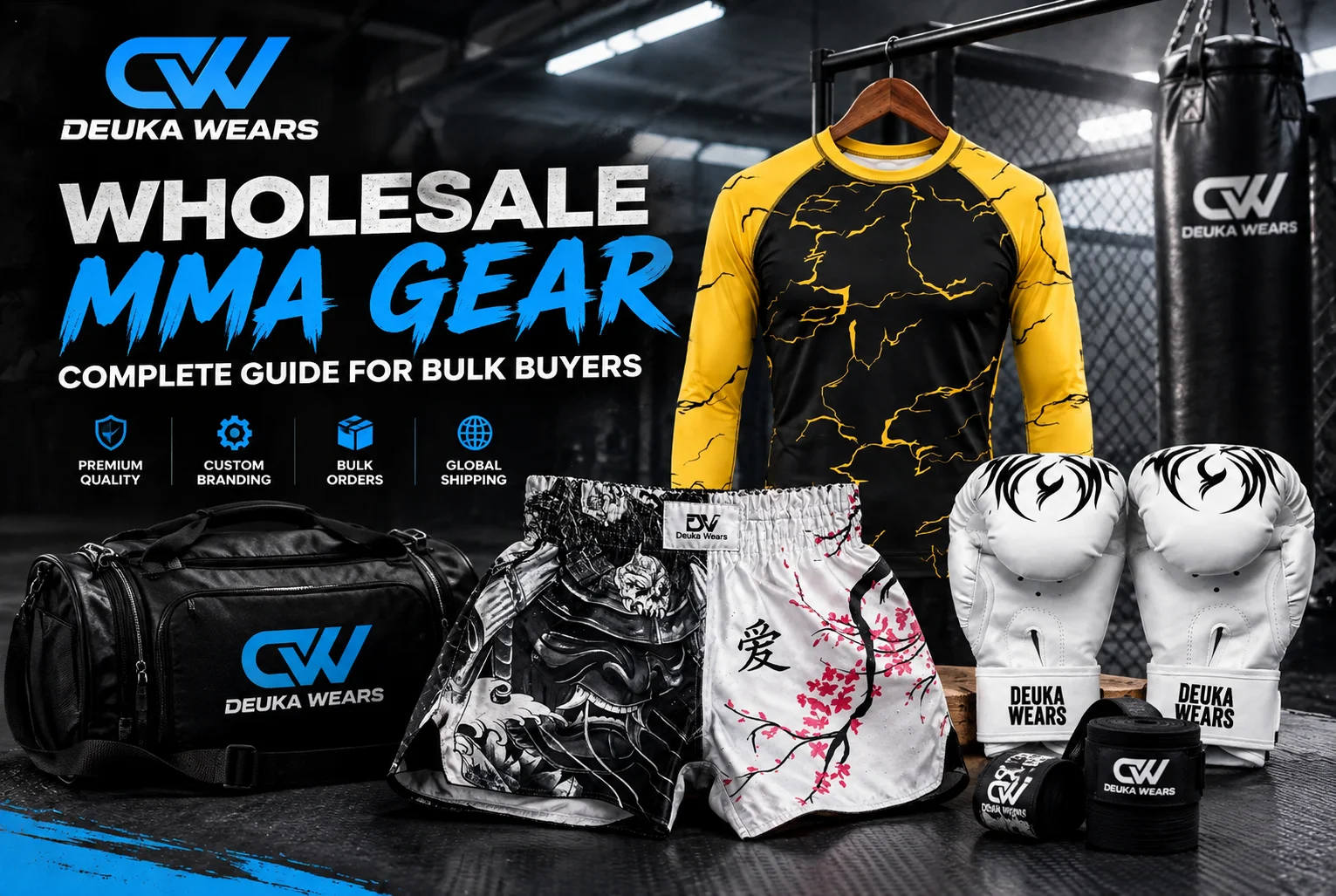
Wholesale MMA Gear: Complete Guide for Bulk Buyers
Buying combat sports equipment in bulk is very different from buying a few items for personal training. A gym may need consistent equipment for dozens of athletes. A retailer needs products that can sell at a healthy margin. A fightwear brand needs reliable manufacturing, custom branding, packaging, and repeat supply.
For these buyers, the right supplier is not simply the one offering the lowest price. You need to consider product quality, materials, customization, minimum order quantities, production consistency, sampling, packaging, lead times, and international shipping.
This guide explains how to approach wholesale MMA gear sourcing, what products to consider, how to evaluate a manufacturer, and what to check before placing a large order.
For businesses looking for a complete range of custom combat products, explore Deuka Wears’ Custom Combat & MMA Wear collection.
What Is Wholesale MMA Gear?
Wholesale MMA gear refers to combat sports equipment and apparel purchased in larger quantities, usually directly from a manufacturer or B2B supplier.
Instead of purchasing individual products at retail prices, businesses order multiple units to:
- Stock a retail store
- Supply a gym or academy
- Launch a fightwear brand
- Resell through e-commerce
- Supply distributors
- Outfit competition teams
- Create private-label collections
- Maintain regular inventory
A bulk purchasing model can include apparel, protective equipment, training products, and branded accessories.
For international buyers, working directly with a manufacturer can also simplify product development, branding, quality control, packaging, and export preparation.
Who Buys MMA Products in Bulk?
The B2B market includes several types of buyers.
MMA and fightwear brands may need custom products manufactured under their own brand identity.
Wholesalers and distributors generally need reliable products at competitive factory pricing so they can supply multiple retailers or markets.
Retailers may purchase ready-to-sell products in larger quantities and need consistent sizing, colors, packaging, and quality.
MMA gyms and academies often need matching training equipment and apparel for coaches, athletes, and members.
New brand owners may start with a smaller production run and increase their order quantities as demand grows.
This makes bulk sourcing relevant across the USA, Canada, UK, Europe, Australia, and other international markets.
Why Businesses Buy Combat Sports Gear in Bulk
Bulk purchasing is not only about getting a lower unit price. It can improve consistency across the entire supply chain.
Lower Cost Per Unit
Manufacturing larger quantities allows production costs to be spread across more units. Depending on the product, materials, customization, and order size, this can create better per-unit economics than purchasing individual products.
However, buyers should compare the total landed cost, not just the factory price.
Consistent Product Quality
A coordinated production run makes it easier to maintain consistent materials, colors, sizing, construction, and branding.
This matters particularly for brands and distributors that need to reorder the same products later.
Better Inventory Planning
A planned bulk order gives businesses more control over stock.
Instead of repeatedly purchasing small quantities, buyers can establish an inventory cycle based on sales, gym membership, seasonal demand, competitions, or retailer requirements.
Stronger Brand Presentation
For private-label businesses, ordering products together makes it easier to maintain one visual identity.
Logo placement, labels, packaging, colorways, and product specifications can be coordinated across a collection.
What Products Should You Include in a Bulk MMA Order?
The right product mix depends on your business model.
A retailer may want a broad range of popular products. A gym may focus on equipment used every day. A fightwear brand may concentrate on apparel and protective products carrying its own branding.
MMA and Training Gloves
Gloves are a core category for combat sports businesses.
When sourcing them in volume, buyers should evaluate:
- Outer material
- Padding construction
- Wrist support
- Closure system
- Stitching
- Weight options
- Size availability
- Branding method
- Color consistency
For businesses looking for custom protective products, Deuka Wears’ Custom Boxing Gloves and Shin Guards can be used as a related product reference.
Fight Shorts and Muay Thai Shorts
Fight shorts need to support movement, striking, grappling, and repeated training.
Important considerations include flexible fabrics, secure waist construction, side openings, reinforced stitching, and durable printing.
For brands developing their own collection, see Custom MMA and Muay Thai Shorts from Deuka Wears.
Rash Guards and Training Apparel
Compression apparel is widely used for grappling, MMA training, BJJ, conditioning, and gym sessions.
When buying these products in quantity, evaluate:
- Fabric stretch
- Moisture management
- Seam construction
- Fit consistency
- Sublimation quality
- Waistband construction
- Color fastness
- Size grading
Deuka Wears offers Custom Rash Guards and Training Sets for businesses developing branded training collections.
Shin Guards and Protective Equipment
Protective products require more than attractive graphics. Padding, shape, closure, material durability, and secure fit all matter.
For bulk buyers, quality should remain consistent from the first unit to the final unit in the production batch.
How to Choose a Wholesale MMA Gear Supplier
Choosing a supplier is one of the most important decisions in the purchasing process.
A low quotation is not enough if the manufacturer cannot maintain quality, meet production requirements, or communicate clearly.
Check Manufacturing Capability
First, determine whether you are dealing with an actual manufacturer, trading company, or reseller.
A manufacturer with in-house production can potentially provide better control over:
- Materials
- Cutting
- Stitching
- Printing
- Embroidery
- Assembly
- Quality inspection
- Packaging
Factory-direct sourcing can also reduce unnecessary intermediaries.
Review Product Experience
A supplier that manufactures combat sports products should understand the demands placed on them.
Ask whether they regularly produce products such as gloves, protective equipment, fight shorts, rash guards, and training apparel.
A specialist manufacturer is usually better positioned to discuss construction details than a general apparel trader.
Ask About Customization
If you are building a brand, customization is essential.
Ask whether the supplier can support:
- Custom colors
- Logos
- Sublimation
- Embroidery
- Woven labels
- Printed labels
- Packaging
- Product specifications
- Custom sizing
- Retail-ready presentation
Confirm Minimum Order Quantities
Minimum order quantity, or MOQ, can vary by product and manufacturing requirements.
Do not assume that one MOQ applies to every item.
Ask the supplier for the MOQ for:
- Apparel
- Gloves
- Shin guards
- Protective equipment
- Custom packaging
- Custom colors
- New designs
For a new brand, a flexible production partner can be particularly valuable because it allows the business to test demand before scaling.
What to Check Before Placing a Bulk Order
Before approving production, create a clear purchasing checklist.
Product Specifications
Every product should have defined specifications.
These may include:
- Materials
- Measurements
- Size chart
- Product weight
- Color references
- Logo dimensions
- Placement
- Stitching requirements
- Closure type
- Padding specifications
- Packaging instructions
A clear specification reduces misunderstandings between the buyer and factory.
Sample Approval
Never rely only on digital artwork when the product is physically important.
A pre-production sample lets you check the actual:
- Fit
- Construction
- Material feel
- Colors
- Branding
- Padding
- Measurements
- Finishing
Once approved, the sample can become the production reference.
Quality Control
A professional bulk order should have defined quality expectations before production starts.
Quality checks can cover:
- Material defects
- Stitching
- Dimensions
- Logo placement
- Color accuracy
- Product symmetry
- Hardware and closures
- Packaging
- Quantity
Consistency matters because a single approved sample does not automatically guarantee that every production unit will match it.
Customization and Private Label Options
For fightwear brands, bulk purchasing often goes together with private-label manufacturing.
Instead of selling generic equipment, a brand can develop products around its own identity.
Custom Branding
Branding options may include:
- Sublimated graphics
- Embroidered logos
- Printed logos
- Woven labels
- Neck labels
- Hang tags
- Custom packaging
The correct method depends on the product material and the desired appearance.
Custom Product Development
More established brands may provide a tech pack or reference sample.
A manufacturer can then work from the buyer’s specifications to develop a sample before moving into production.
This approach is useful when the product needs a specific fit, construction, colorway, or functional feature.
Build a Consistent Product Collection
Instead of ordering unrelated products, brands can develop coordinated collections.
For example:
- Fight shorts
- Rash guards
- Training tops
- Gloves
- Shin protection
- Accessories
Using consistent branding across the range creates a stronger retail presentation.
Keep Product Specifications Consistent
Once a product is approved, keep its specifications documented.
This helps when you reorder the same item several months later and reduces the risk of unwanted changes.
Record Every Approved Detail
Keep the final size chart, material specification, artwork, Pantone references, label placement, packaging instructions, and approved sample information together.
This simple step can make repeat production much easier.
How Much MMA Gear Should You Order?
There is no universal quantity that works for every buyer.
The correct order size depends on your business model, sales history, available storage, product range, and expected demand.
New Fightwear Brands
A new brand should avoid tying too much cash into slow-moving inventory.
A smaller initial production run can be useful for testing:
- Product demand
- Customer response
- Popular sizes
- Popular colors
- Best-selling designs
Once the winning products become clear, larger repeat orders can be planned.
Established Retailers
Retailers with sales history can use previous order data to estimate demand.
Instead of ordering equal quantities of every size, use sales records to identify which products and sizes move fastest.
Gyms and Academies
A gym may need a different purchasing strategy.
The order could be based on:
- Number of active members
- Class size
- Coaching staff
- Training frequency
- Replacement requirements
- New-member packages
For recurring programs, standardizing products can simplify future replacements.
What Makes a Good Bulk-Order Partner?
A strong supplier relationship should go beyond one transaction.
Look for a manufacturer that can provide:
- Clear communication
- Consistent product quality
- Transparent specifications
- Reliable sampling
- Practical MOQ options
- Custom branding support
- Quality inspection
- Proper packaging
- Export experience
- Responsive after-sales communication
Communication Matters
International B2B orders often involve detailed requirements.
A good supplier should be able to understand product specifications and communicate clearly about sampling, production, packaging, and shipping.
This becomes even more important when the buyer operates in a different time zone or country.
Think About Repeat Orders
The cheapest first order is not always the best long-term choice.
If you plan to reorder, consider whether the manufacturer can maintain:
- Product consistency
- Materials
- Colors
- Sizing
- Branding
- Packaging
- Production standards
A dependable relationship can be more valuable than a small difference in the first quotation.
Shipping and Logistics for International Buyers
Bulk orders require more planning than individual online purchases.
International buyers should discuss shipping before confirming production.
Depending on the order size and destination, options may include air freight, sea freight, or express services.
Plan Around Lead Times
Ask for an estimated timeline covering:
- Design confirmation
- Sampling
- Sample approval
- Material preparation
- Bulk production
- Quality inspection
- Packing
- Dispatch
- International transit
Do not plan your inventory around the production time alone. Shipping and customs can also affect the final delivery date.
Prepare Export Information
International buyers should confirm the commercial documentation and shipping information required for their market before production begins.
This is particularly important for larger shipments entering the USA, Canada, UK, Europe, Australia, or other international markets.
Wholesale MMA Gear Buying Checklist
Before placing your order, review this checklist.
Supplier Checklist
- Is the company a manufacturer or reseller?
- Does it have combat-sports manufacturing experience?
- Can it support your required quantity?
- Does it offer samples?
- Can it provide customization?
- Is the MOQ suitable for your business?
- Does it have international shipping experience?
Product Checklist
- Are materials clearly specified?
- Are measurements confirmed?
- Is the size chart approved?
- Are colors finalized?
- Is branding placement approved?
- Are construction details documented?
- Has the physical sample been approved?
Commercial Checklist
- Is the quotation clear?
- Are production terms understood?
- Are payment terms confirmed?
- Is the expected production schedule clear?
- Is packaging included?
- Is shipping responsibility defined?
- Are repeat-order requirements documented?
Why Work With Deuka Wears for Bulk Combat Sports Orders?
Deuka Wears is a Pakistan-based custom sportswear manufacturer serving international B2B customers.
For combat sports businesses, the company supports custom apparel and equipment production for brands, wholesalers, distributors, retailers, gyms, academies, and other buyers.
Its manufacturing model is designed around custom development, bulk production, branding, quality control, and international delivery.
For buyers building a complete combat collection, the Deuka Wears Combat & MMA Wear collection provides a starting point for exploring available categories.
Whether you are developing a new fightwear label, supplying a gym network, stocking a retail business, or expanding an existing product range, the right manufacturing partner can help turn your product requirements into a repeatable supply program.
Final Thoughts
Buying combat sports products in bulk should be treated as a sourcing decision, not simply a shopping decision.
The right supplier should offer more than a low quotation. You need consistent manufacturing, clear specifications, reliable samples, suitable MOQs, customization capabilities, quality control, packaging support, and international logistics.
For MMA and fightwear brands, wholesalers, distributors, retailers, gyms, academies, and new business owners, a structured purchasing process reduces risk and makes it easier to build a reliable product range.
Start by defining your products and quantities. Then compare manufacturers based on quality, capabilities, communication, production requirements, and long-term supply potential.
A carefully planned bulk order can give your business better product consistency, stronger branding, healthier margins, and a more dependable inventory strategy.

Leave a comment