
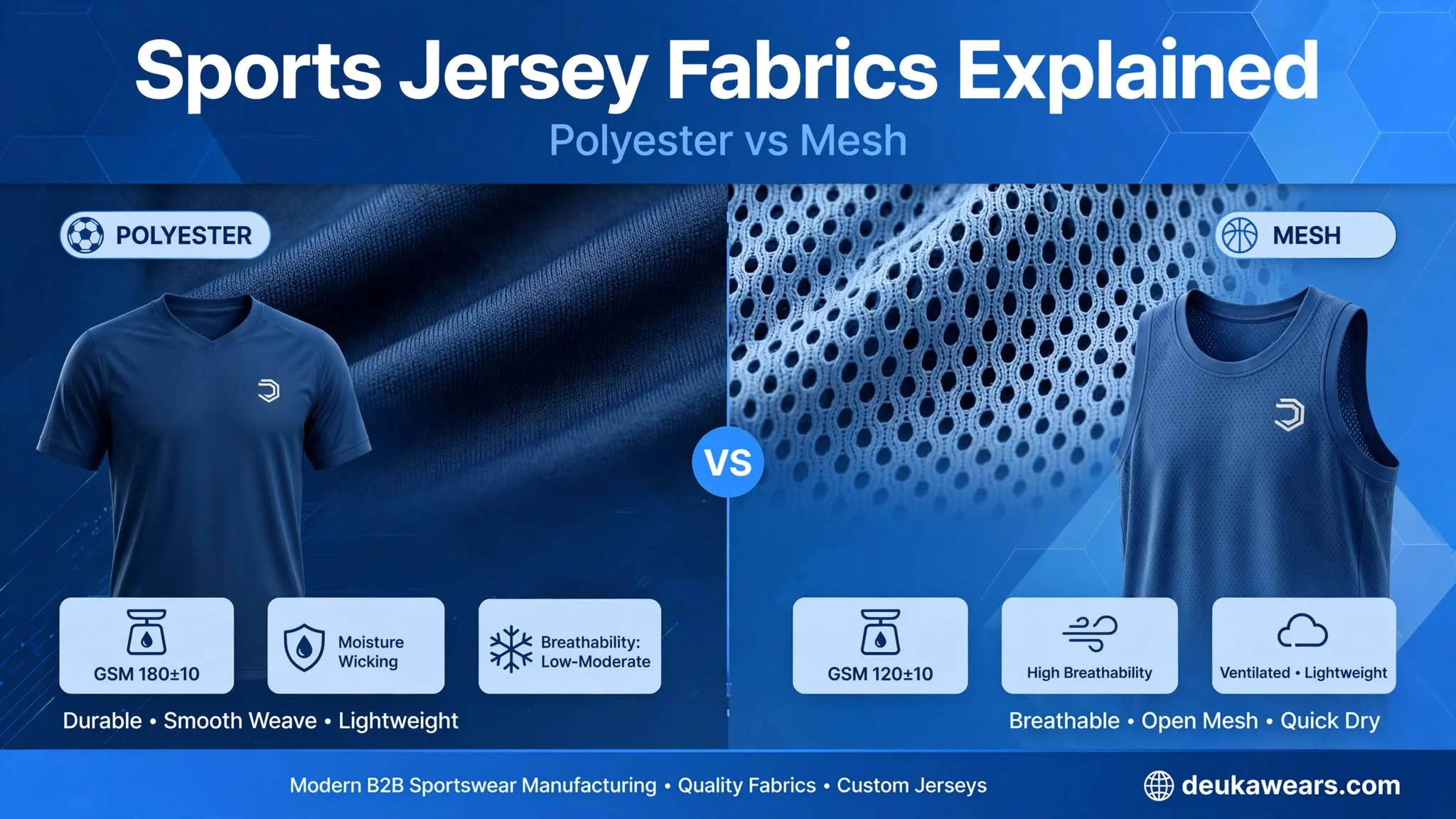
Sports Jersey Fabrics Explained: Polyester vs Mesh
When developing custom teamwear, fabric selection is one of the decisions that can affect almost every part of the finished jersey.
The fabric influences comfort, breathability, weight, moisture management, durability, appearance, printing performance, and even how the jersey should be positioned for a particular sport.
Two terms that frequently appear when sourcing sports jerseys are polyester and mesh. At first, they may seem like two completely different material choices. However, there is an important distinction: polyester describes a fiber, while mesh generally describes a fabric construction.
That means a sports jersey can actually be made from polyester mesh.
Understanding this difference helps teams, sportswear brands, wholesalers, retailers, and international buyers make better sourcing decisions.
This guide explains how polyester and mesh differ, how GSM affects jersey performance, how fabric choice works with sublimation, and what buyers should consider before ordering custom sports jerseys in bulk.
1. What Are Sports Jersey Fabrics?
Sports jersey fabrics are materials selected specifically for athletic garments and team uniforms.
Unlike everyday fashion apparel, sports jerseys need to handle movement, perspiration, repeated washing, and regular use. The fabric also needs to work with the garment’s construction, fit, decoration method, and intended sport.
Important fabric considerations can include:
- Breathability
- Moisture management
- Drying speed
- Weight
- Durability
- Stretch
- Shape retention
- Color performance
- Printing compatibility
- Comfort
- Overall garment construction
The correct choice depends on the application.
A basketball jersey used during intense indoor play may prioritize airflow, while a baseball jersey may require a different balance of structure and durability. A cycling jersey has its own requirements around fit, ventilation, and movement.
For B2B buyers, fabric selection should therefore be treated as part of product development, not as an afterthought.
2. Polyester Sports Jersey Fabric Explained
Polyester is one of the most widely used fibers in modern performance sportswear.
It is popular because it can be manufactured into different fabric constructions designed for lightweight performance, durability, moisture management, and customization.
Polyester is also commonly selected for sublimation sportswear, making it particularly relevant for teams and brands that want detailed all-over graphics.
Why Is Polyester Commonly Used for Sports Jerseys?
Polyester can offer several useful characteristics for teamwear:
- Lightweight options
- Good durability
- Quick-drying performance
- Good shape retention
- Low shrinkage compared with many natural fibers
- Compatibility with sublimation
- Easy-care characteristics
- Suitability for repeated sports use
However, saying that a jersey is “polyester” does not provide the complete fabric specification.
Different polyester fabrics can have different weights, constructions, textures, stretch levels, and performance characteristics.
When Does Polyester Make Sense?
A polyester construction can be a practical choice when a team or brand needs a balance of performance and customization.
It can be suitable for:
- Soccer jerseys
- Basketball jerseys
- Baseball jerseys
- American football uniforms
- Training shirts
- Team practice wear
- Cycling apparel
- General performance tops
For example, a soccer brand developing a coordinated uniform may need a fabric that works with detailed graphics while remaining suitable for repeated training and match use. In that situation, custom soccer jerseys and shorts can be developed around the intended fabric, design, and performance requirements rather than treating those decisions separately.
3. Mesh Sports Jersey Fabric Explained
Mesh is different from polyester because the word “mesh” generally refers to the structure of the fabric rather than the fiber itself.
Many sports meshes are made from polyester.
The open construction of mesh creates spaces within the fabric that can allow more air to move through the garment.
This makes mesh particularly useful when ventilation is an important part of the product specification.
Why Is Mesh Used in Sports Jerseys?
The main reason for using mesh is improved airflow.
Depending on its construction, mesh can provide:
- Increased ventilation
- Lightweight feel
- Greater airflow
- Comfortable performance in warm conditions
- Athletic appearance
- Useful breathability for training and competition
Mesh does not necessarily need to cover the entire garment.
It can also be incorporated into selected areas such as the back, sides, shoulders, or underarms.
Where Is Mesh Commonly Used?
Mesh constructions are commonly considered for garments such as:
- Basketball jerseys
- Training tops
- Practice uniforms
- Sports pinnies
- Breathable teamwear
- Warm-weather sports apparel
This is particularly relevant for products designed around lightweight construction. For example, pinnies and mesh jerseys naturally fit applications where teams need an easy-to-wear layer with airflow and visibility.
4. Polyester vs Mesh: What Is the Difference?
The most important point is that polyester and mesh should not always be treated as two opposing materials.
Polyester identifies the fiber, while mesh generally identifies the fabric construction.
A manufacturer can therefore produce a polyester mesh jersey.
The practical comparison is often between a more conventional polyester fabric construction and a more open mesh construction.
| Feature | Standard Polyester | Polyester Mesh |
| Fiber | Usually polyester | Often polyester |
| Construction | More compact | Open or perforated |
| Airflow | Good depending on construction | Generally higher |
| Breathability | Good to very good | Generally very high |
| Weight | Varies | Often lightweight |
| Moisture management | Depends on construction | Depends on construction |
| Sublimation suitability | Often very suitable | Depends on specific mesh |
| Coverage | More consistent | More open |
| Common applications | General teamwear | Training, basketball, breathable teamwear |
Fabric performance still depends on yarn, knit construction, GSM, finishing, garment design, and intended use.
Why the Construction Matters More Than the Label
Two fabrics can both be called polyester but provide noticeably different wearing experiences.
One may have a compact surface and more structured feel, while another may be lightweight and highly breathable.
This is why B2B buyers should request complete specifications instead of asking a manufacturer for “polyester fabric” alone.
What Should Be Compared?
When evaluating two fabric options, compare:
- Fiber composition
- Fabric construction
- GSM
- Weight
- Breathability
- Stretch
- Surface texture
- Printing compatibility
- Intended sport
- Expected use conditions
This creates a much clearer basis for selecting a sports jersey fabric.
5. Which Is More Breathable: Polyester or Mesh?
If the comparison is between a conventional polyester construction and an open polyester mesh, mesh will generally provide more airflow.
That does not mean every mesh is automatically more comfortable or that every polyester fabric has poor ventilation.
Breathability depends on the complete construction.
A lightweight polyester knit may perform well in warm conditions, while a jersey can also combine a main polyester body with mesh panels to increase airflow in selected areas.
What Affects Jersey Breathability?
Several factors can affect how breathable a jersey feels:
- Fabric construction
- Fabric weight
- Open area
- Garment fit
- Panel placement
- Climate
- Activity intensity
- Layering
- Finishing
This is why fabric should be evaluated as part of the finished garment rather than considered in isolation.
Think About the Complete Jersey
A jersey’s breathability is influenced by more than its fabric name.
Consider Where Heat Builds Up
Areas such as the back, side panels, and underarms may benefit from increased airflow depending on the sport and garment design.
Match Ventilation to the Sport
A high-intensity basketball jersey may require different ventilation planning than a baseball jersey or an American football uniform.
This sport-specific approach can help manufacturers and buyers avoid using one fabric specification across every product.
6. Moisture Management and Quick-Drying Performance
Moisture management is another important factor when selecting sports jersey fabrics.
Polyester is widely used in performance apparel because suitable constructions can move moisture away from the skin and dry relatively quickly.
Mesh can complement this performance by allowing greater airflow through the garment.
However, buyers should not assume that every polyester fabric or every mesh construction provides exactly the same moisture-management performance.
Why Does Moisture Management Matter?
Athletes can generate considerable heat and perspiration during training and competition.
A suitable sports jersey should therefore be selected according to:
- Sport intensity
- Playing duration
- Climate
- Indoor or outdoor use
- Expected washing frequency
- Garment weight
- Fabric construction
How Should Buyers Evaluate It?
Instead of relying only on a product description, request fabric information and samples.
A physical sample can help evaluate the fabric’s:
- Hand feel
- Weight
- Airflow
- Surface texture
- Drying characteristics
- Overall comfort
This is especially important when developing a new product line or placing a significant bulk order.
7. Does GSM Matter for Sports Jersey Fabrics?
Yes. GSM means grams per square meter and is commonly used to describe fabric weight.
GSM is useful when comparing fabric specifications, but it should not be treated as a simple quality rating.
A higher GSM does not automatically mean a better sports jersey.
Similarly, a lower GSM does not automatically mean poor quality.
Fabric construction, yarn, finishing, and intended application all matter.
How Can Fabric Weight Affect a Jersey?
A lighter fabric may provide:
- Lower overall garment weight
- Lightweight feel
- Greater suitability for warm conditions
- Easier movement
A heavier fabric may provide:
- More structure
- Greater coverage
- Different durability characteristics
- A more substantial hand feel
What Should Buyers Request From a Manufacturer?
A useful fabric specification should go beyond GSM.
Ask for Fiber and Construction Details
Request:
- Fiber composition
- GSM
- Knit or woven construction
- Stretch characteristics
- Surface finish
- Printing compatibility
- Intended application
Compare Samples With the Specification
The physical sample should match the agreed specification as closely as possible.
This creates a clearer reference point for bulk production and future repeat orders.
8. How Does Fabric Choice Affect Sublimation Printing?
Fabric selection and printing methods should be considered together.
Sublimation is widely used in custom sportswear because suitable polyester fabrics can accept detailed designs through the sublimation process.
This makes fabric selection particularly important for teams that want full-color graphics, gradients, logos, names, numbers, and all-over patterns.
Teams that want to understand the printing process in more detail can also explore What Is Sublimation Printing? Complete Guide for Teams before finalizing their jersey specifications.
Why Is Polyester Commonly Used for Sublimation?
Sublimation works particularly well with suitable polyester-based fabrics because the printing process is designed around synthetic fibers.
This can support designs containing:
- Multiple colors
- Detailed graphics
- Team logos
- Player names
- Player numbers
- Gradients
- Repeating patterns
- Full-coverage artwork
Does Every Polyester Mesh Work the Same Way?
No.
Different mesh constructions can behave differently during printing.
Test the Actual Fabric
If a design depends on precise color reproduction or detailed graphics, the actual fabric should be tested before bulk production.
Approve a Finished Sample
A finished sample allows the buyer to evaluate both the fabric and the final printed result before approving a larger production run.
9. Polyester vs Mesh for Different Sports
There is no single sports jersey fabric that works perfectly for every sport.
The best construction depends on how the garment will be used.
Basketball Jerseys
Basketball involves continuous movement and high activity levels, making airflow and lightweight construction important considerations.
Mesh is often attractive for this type of garment because ventilation can be a key requirement.
At the same time, the final specification should consider the team’s preferred fit, graphics, durability, and printing method.
For teams developing basketball uniforms, basketball jerseys and shorts can be considered as part of the complete uniform specification.
Soccer Jerseys
Soccer jerseys need to balance lightweight performance, movement, breathability, and durability.
A suitable polyester construction can provide a useful base for detailed team customization.
For this reason, buyers should consider fabric, fit, and decoration together when developing a soccer uniform.
American Football Jerseys
American football creates different requirements because uniforms may be worn with protective equipment and need to withstand physical contact.
Fabric selection should therefore be considered alongside garment construction, fit, durability, and the complete uniform system.
For teams and brands developing this type of product, custom football jersey and pants manufacturing provides a relevant product-development reference.
Baseball Jerseys
Baseball jerseys can require a more structured appearance depending on the team’s preferred style.
A full-button jersey, for example, has different construction considerations from a lightweight practice top.
Teams looking for this type of uniform can review full-button and V-neck baseball jerseys when considering the relationship between fabric, construction, and final appearance.
Ice Hockey Jerseys
Ice hockey jerseys need to account for movement, layering, durability, and the physical demands of the sport.
Fabric should therefore be considered alongside the overall jersey construction and fit.
For hockey teamwear projects, custom hockey jerseys are another example where the fabric specification needs to support the complete garment design.
Cycling Jerseys
Cycling creates specific requirements around body movement, fit, ventilation, and moisture management.
A cycling jersey should therefore be developed around the athlete’s position and intended use rather than simply using a generic teamwear fabric.
For a product-specific example, cycling jerseys and bib shorts can be developed with sport-specific fabric and construction requirements in mind.
10. Should You Choose Polyester or Mesh for Custom Teamwear?
The right choice depends on what the jersey needs to achieve.
Rather than asking which fabric is universally better, buyers should match the construction to the sport and end-use conditions.
When Should You Choose a Standard Polyester Construction?
A standard polyester construction can make sense when:
- You need versatile teamwear
- Full-color customization is important
- Sublimation is part of the design process
- The garment needs consistent coverage
- Durability is important
- The jersey will be used in different environments
- You need a practical option for bulk production
When Should You Consider Mesh?
Mesh may be more appropriate when:
- Airflow is a major priority
- The jersey will be used in warm conditions
- Athletes generate significant heat
- Lightweight construction is preferred
- Practice or training use is the main application
Can Both Constructions Be Used Together?
Yes, depending on the garment design and manufacturing process.
A jersey may use a primary polyester body while incorporating mesh panels in selected areas.
Why Use Hybrid Construction?
A combination can help balance:
- Coverage
- Airflow
- Appearance
- Durability
- Weight
- Design requirements
Where Can Mesh Panels Be Used?
Depending on the garment, mesh can be considered for areas such as:
- Side panels
- Back panels
- Underarms
- Shoulder areas
- Other ventilation zones
The exact construction should be determined according to the sport and garment pattern.
11. What Should B2B Buyers Ask a Sportswear Manufacturer?
Fabric sourcing becomes more important when an order is intended for a team, retail collection, wholesale program, or private-label sportswear brand.
Before approving production, buyers should ask for clear fabric specifications.
Questions About Fabric Composition
Ask the manufacturer:
- What is the fiber composition?
- What is the GSM?
- What type of construction is used?
- Is the fabric suitable for sublimation?
- Does it contain stretch fibers?
- What is the expected hand feel?
- Is the fabric intended for training or competition?
- Can a fabric sample be provided?
Questions About Production
Buyers should also clarify:
- Available customization
- Sample development
- Artwork requirements
- Printing method
- Size range
- Quality-control process
- Packaging requirements
- Bulk-order specifications
- Shipping requirements
Why Should Fabric Be Approved Before Bulk Production?
Fabric selection can affect the final appearance and performance of the complete jersey.
Check the Fabric Before Approving Bulk Production
Do not evaluate the material only from a written specification.
Request a physical fabric or finished-garment sample and check:
- Hand feel
- Weight
- Stretch
- Airflow
- Surface texture
- Color
- Print appearance
- Stitching
- Overall comfort
Evaluate the Finished Jersey
A loose fabric swatch does not show everything.
The finished garment may feel different because of the pattern, seams, printing, fit, and construction.
For larger B2B orders, evaluating a finished sample before bulk production gives buyers a more realistic reference for the final product.
12. Fabric Selection for International and Global Sportswear Buyers
Sportswear buyers across the USA, Canada, Europe, South America, Asia, Oceania, and Africa may have different requirements based on climate, sport, market positioning, and end-user expectations.
A teamwear product intended for a hot climate may prioritize airflow, while a product intended for a cooler environment may require a different balance of coverage and weight.
International sourcing also makes specification clarity especially important.
What Should Global Buyers Consider?
Before selecting a fabric, consider:
- Target sport
- Climate
- Performance requirements
- Jersey weight
- Printing method
- Target customer
- Expected order volume
- Washing requirements
- Product positioning
- End-user expectations
Why Should Fabric Specifications Be Documented?
For repeat orders, a clear fabric specification helps buyers communicate the same requirements across future production cycles.
This becomes especially useful for brands and wholesalers managing multiple product categories.
Create a Product-Specific Fabric Specification
Keep Each Jersey Category Clearly Defined
For example, a basketball jersey, soccer jersey, baseball jersey, and cycling jersey should not automatically share the same fabric specification.
Match the Fabric to the Product
The goal is not to use the same material everywhere. The goal is to select a construction that supports the requirements of each product.
13. Common Sports Jersey Fabric Selection Mistakes
Choosing the wrong fabric can create problems with comfort, printing, durability, and customer expectations.
Choosing Fabric Only by Price
The cheapest fabric is not automatically the most cost-effective choice.
A lower initial material cost may not provide the performance or product feel required by the target customer.
Assuming All Polyester Is the Same
Polyester is a fiber category, not a complete performance specification.
Different constructions can produce very different results.
Treating Mesh as a Separate Fiber
Mesh usually describes fabric construction.
Many sports meshes are polyester, so buyers should ask about both the fiber and construction.
Ignoring GSM
GSM provides useful information about fabric weight and should be considered alongside construction and application.
Choosing Fabric Before the Printing Method
A fabric should be compatible with the decoration method planned for the final jersey.
Skipping Sample Approval
A sample gives buyers an opportunity to evaluate the actual product before committing to bulk production.
14. How Fabric Choice Affects Wholesale Sportswear
For wholesalers, retailers, distributors, and sportswear brands, fabric selection affects more than athlete comfort.
It can influence:
- Product positioning
- Manufacturing cost
- Printing options
- Customer expectations
- Product consistency
- Repeat orders
- Wholesale specifications
- Collection development
A business developing several sportswear categories should maintain clear material specifications for each product rather than treating all jerseys as identical.
For buyers managing larger sportswear programs, Wholesale & Bulk Sportswear Ordering can be considered alongside product-specific fabric, customization, and production requirements.
For combat-sports brands, fabric selection is also part of broader product development. Buyers building a complete MMA collection can reference Wholesale MMA Gear: Complete Guide for Bulk Buyers when planning bulk sourcing across different combat-wear products.
15. How Deuka Wears Supports Custom Sportswear Development
Fabric selection works best when it is considered together with design, customization, printing, garment construction, and production requirements.
Deuka Wears supports custom sportswear development for teams, brands, retailers, wholesalers, and international B2B buyers looking to develop sports apparel around specific product requirements.
For brands that need detailed graphics or custom team designs, Custom Sublimation & Sportswear Design can be relevant because the printing process needs to be considered alongside the selected fabric.
The same principle applies when a business is developing a new sportswear brand. Product development should begin with the intended customer, sport, fabric, design, and manufacturing requirements rather than selecting a material in isolation.
Frequently Asked Questions About Sports Jersey Fabrics
What is the best fabric for sports jerseys?
There is no single best fabric for every sports jersey. Polyester is widely used for performance teamwear, while polyester mesh can be useful when increased airflow is required. The right choice depends on sport, climate, construction, printing method, and intended use.
Is polyester or mesh better for sports jerseys?
Mesh can provide greater airflow because of its open construction, while a standard polyester construction can offer a useful balance of durability, coverage, customization, and performance. Since mesh can also be made from polyester, the comparison is often about construction rather than fiber alone.
Is polyester good for sublimation sports jerseys?
Yes. Suitable polyester fabrics are widely used for sublimated sports jerseys because they can support detailed, full-color designs. The specific fabric should still be tested before bulk production.
What does GSM mean in sports jersey fabric?
GSM means grams per square meter and indicates fabric weight. It is useful for comparing materials, but it should be evaluated together with fiber composition, construction, finishing, and intended application.
Should I request a fabric sample before placing a bulk sportswear order?
Yes. A fabric or finished-garment sample can help buyers evaluate weight, hand feel, breathability, stretch, appearance, printing performance, and overall construction before approving bulk production.
Conclusion: Choosing the Right Sports Jersey Fabric
Selecting sports jersey fabrics is not simply a matter of choosing between polyester and mesh.
Polyester describes the fiber, while mesh generally describes the construction. Many sports meshes are themselves made from polyester, which means the real decision often involves comparing different fabric constructions for a particular sportswear application.
For teams, brands, wholesalers, retailers, and international buyers, the selection should consider:
- Sport
- Climate
- Breathability
- Moisture management
- GSM
- Durability
- Printing method
- Garment construction
- Target market
- Bulk production requirements
A lightweight mesh may make sense for a highly breathable basketball or training jersey, while a different polyester construction may be better suited to a soccer, baseball, football, or cycling product.
The most reliable approach is to define the product requirements, compare appropriate fabric specifications, request samples, evaluate the finished garment, and approve the final construction before bulk production.
When fabric, design, printing, and garment construction are planned together, sportswear brands and teams can create jerseys that are better aligned with both athletic requirements and customer expectations.
Deuka Wears can support teams, brands, retailers, wholesalers, and international buyers with custom sportswear development where fabric selection, design, customization, and production need to work together.

Leave a comment