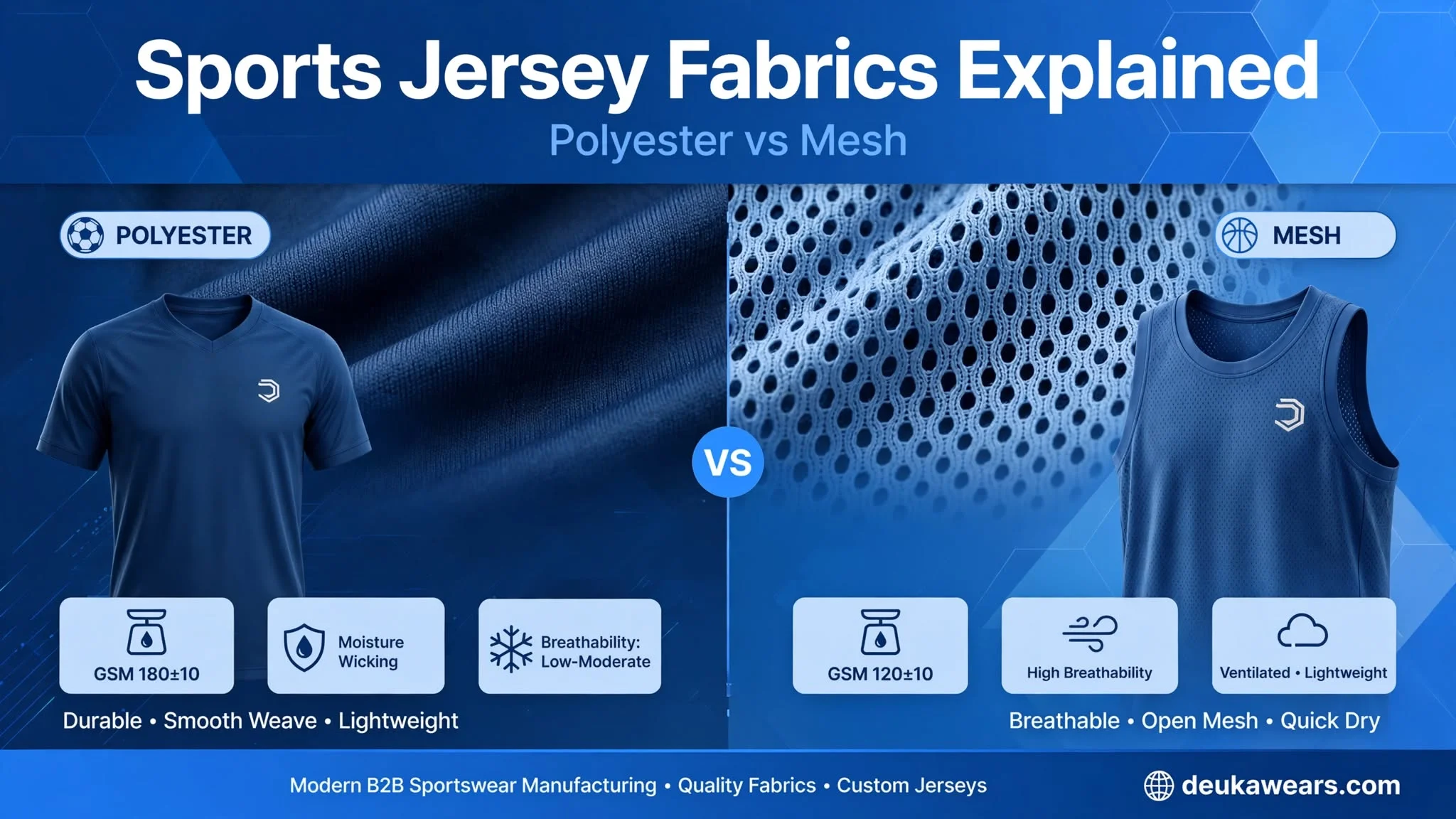
When developing custom teamwear, fabric selection is one of the decisions that can affect almost every part of the finished jersey.
The fabric influences comfort, breathability, weight, moisture management, durability, appearance, printing performance, and even how the jersey should be positioned for a particular sport.
Two terms that frequently appear when sourcing sports jerseys are polyester and mesh. At first, they may seem like two completely different material choices. However, there is an important distinction: polyester describes a fiber, while mesh generally describes a fabric construction.
That means a sports jersey can actually be made from polyester mesh.
Understanding this difference helps teams, sportswear brands, wholesalers, retailers, and international buyers make better sourcing decisions.
This guide explains how polyester and mesh differ, how GSM affects jersey performance, how fabric choice works with sublimation, and what buyers should consider before ordering custom sports jerseys in bulk.
1. What Are Sports Jersey Fabrics?
Sports jersey fabrics are materials selected specifically for athletic garments and team uniforms.
Unlike everyday fashion apparel, sports jerseys need to handle movement, perspiration, repeated washing, and regular use. The fabric also needs to work with the garment’s construction, fit, decoration method, and intended sport.
Important fabric considerations can include:
- Breathability
- Moisture management
- Drying speed
- Weight
- Durability
- Stretch
- Shape retention
- Color performance
- Printing compatibility
- Comfort
- Overall garment construction
The correct choice depends on the application.
A basketball jersey used during intense indoor play may prioritize airflow, while a baseball jersey may require a different balance of structure and durability. A cycling jersey has its own requirements around fit, ventilation, and movement.
For B2B buyers, fabric selection should therefore be treated as part of product development, not as an afterthought.
2. Polyester Sports Jersey Fabric Explained
Polyester is one of the most widely used fibers in modern performance sportswear.
It is popular because it can be manufactured into different fabric constructions designed for lightweight performance, durability, moisture management, and customization.
Polyester is also commonly selected for sublimation sportswear, making it particularly relevant for teams and brands that want detailed all-over graphics.
Why Is Polyester Commonly Used for Sports Jerseys?
Polyester can offer several useful characteristics for teamwear:
- Lightweight options
- Good durability
- Quick-drying performance
- Good shape retention
- Low shrinkage compared with many natural fibers
- Compatibility with sublimation
- Easy-care characteristics
- Suitability for repeated sports use
However, saying that a jersey is “polyester” does not provide the complete fabric specification.
Different polyester fabrics can have different weights, constructions, textures, stretch levels, and performance characteristics.
When Does Polyester Make Sense?
A polyester construction can be a practical choice when a team or brand needs a balance of performance and customization.
It can be suitable for:
- Soccer jerseys
- Basketball jerseys
- Baseball jerseys
- American football uniforms
- Training shirts
- Team practice wear
- Cycling apparel
- General performance tops
For example, a soccer brand developing a coordinated uniform may need a fabric that works with detailed graphics while remaining suitable for repeated training and match use. In that situation, custom soccer jerseys and shorts can be developed around the intended fabric, design, and performance requirements rather than treating those decisions separately.
3. Mesh Sports Jersey Fabric Explained
Mesh is different from polyester because the word “mesh” generally refers to the structure of the fabric rather than the fiber itself.
Many sports meshes are made from polyester.
The open construction of mesh creates spaces within the fabric that can allow more air to move through the garment.
This makes mesh particularly useful when ventilation is an important part of the product specification.
Why Is Mesh Used in Sports Jerseys?
The main reason for using mesh is improved airflow.
Depending on its construction, mesh can provide:
- Increased ventilation
- Lightweight feel
- Greater airflow
- Comfortable performance in warm conditions
- Athletic appearance
- Useful breathability for training and competition
Mesh does not necessarily need to cover the entire garment.
It can also be incorporated into selected areas such as the back, sides, shoulders, or underarms.
Where Is Mesh Commonly Used?
Mesh constructions are commonly considered for garments such as:
- Basketball jerseys
- Training tops
- Practice uniforms
- Sports pinnies
- Breathable teamwear
- Warm-weather sports apparel
This is particularly relevant for products designed around lightweight construction. For example, pinnies and mesh jerseys naturally fit applications where teams need an easy-to-wear layer with airflow and visibility.