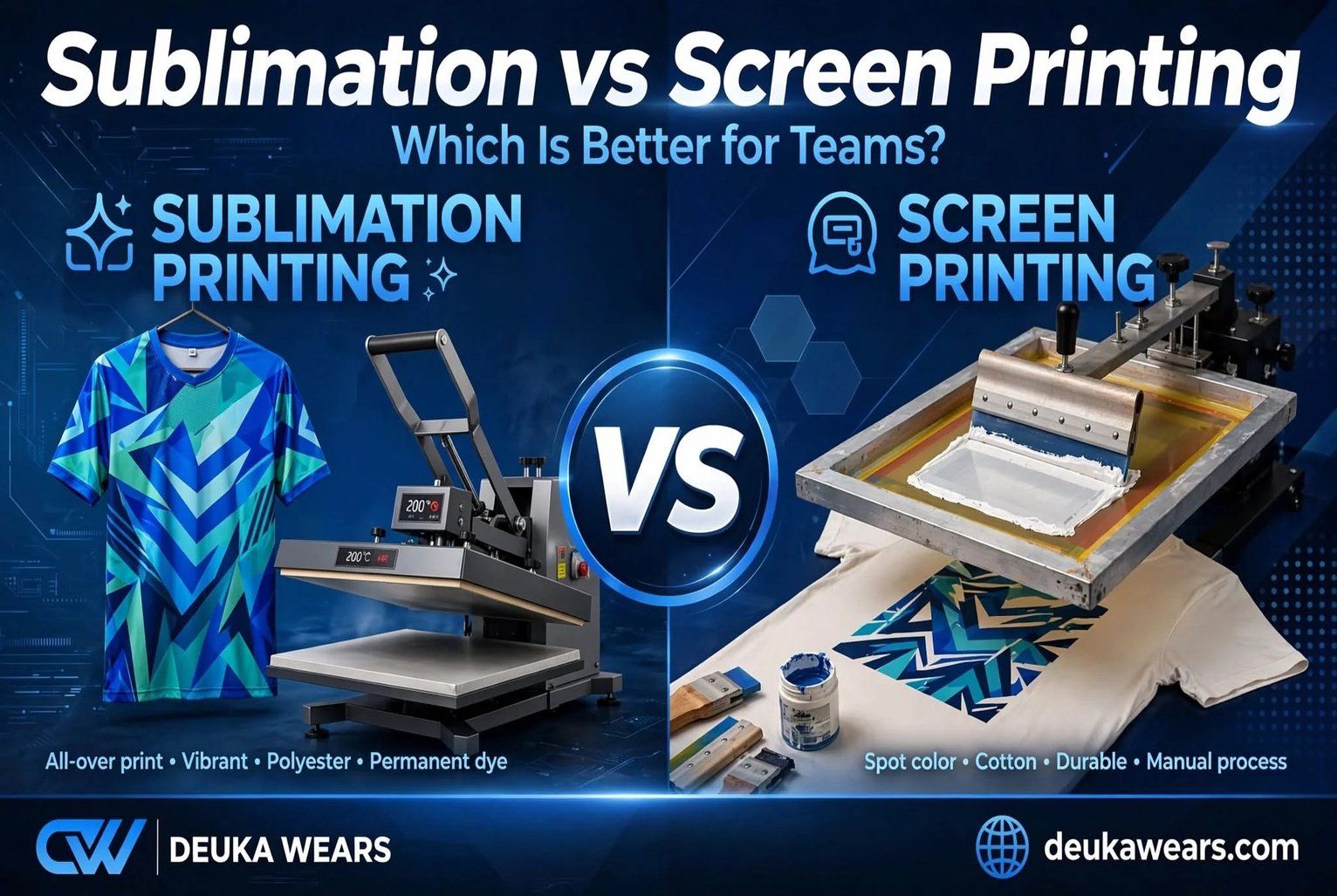
Sublimation vs Screen Printing: Which Is Better for Teams?
When ordering custom teamwear, one of the first decisions is choosing the right printing method. Sublimation vs Screen Printing is a common comparison because both methods can produce professional-looking sports apparel, but they work very differently.
Sublimation is commonly used for detailed designs on suitable polyester sportswear. Screen printing applies ink to the surface of the garment and can work across a wider range of fabrics.
The right option depends on your fabric, design, colors, order quantity, personalization, budget, and intended use.
For a US sports team ordering custom jerseys, the answer may be different from a retailer ordering hundreds of cotton team shirts. The same applies to buyers in the UK, Canada, Australia, Europe, and the Middle East.
This guide compares both methods so you can choose based on your actual teamwear requirements rather than simply choosing the method with the lowest quoted price.
Sublimation vs Screen Printing: What Is the Difference?
The biggest difference is how the design becomes attached to the garment.
Sublimation uses special dye and heat to transfer the design into suitable polyester fibers. The color becomes part of the material rather than forming a conventional layer on top.
Screen printing pushes ink through a mesh screen onto the garment surface. Different colors generally require separate screens and printing steps.
This basic difference affects almost everything else, including fabric compatibility, design complexity, surface feel, customization, and production costs.
How Sublimation Works
With sublimation, the artwork is digitally printed onto transfer paper using sublimation inks.
Heat and pressure are then used to transfer the dye into suitable polyester material.
Because the color is integrated into the fabric, sublimation is well suited to detailed team jerseys, gradients, patterns, names, numbers, and all-over artwork.
Where Sublimation Works Best
Sublimation is particularly useful when a team wants:
- Full-color artwork
- Multiple colors
- Gradients
- Detailed graphics
- All-over patterns
- Player names and numbers
- Sponsor logos
- Custom designs across multiple panels
- Polyester performance fabrics
How Screen Printing Works
Screen printing uses a mesh screen to apply ink to a garment.
Each part of the artwork is prepared as a stencil, and ink is pushed through the open areas of the screen onto the fabric.
Additional colors normally require additional screens and printing stages.
This makes screen printing particularly practical for straightforward artwork with a limited number of colors.
Where Screen Printing Works Best
Screen printing can be useful for:
- Simple team logos
- Practice shirts
- Fan apparel
- Event shirts
- Spirit wear
- Cotton garments
- Dark-colored garments
- Large orders with repeated artwork
- Designs using a small number of colors
Sublimation vs Screen Printing: Quick Comparison
| Factor | Sublimation | Screen Printing |
| Main fabric | Polyester and suitable synthetic materials | Many fabric types |
| Design complexity | Excellent for detailed artwork | Best for simpler artwork |
| Full-garment coverage | Excellent | Generally less practical |
| Number of colors | Very flexible | More colors add production steps |
| Gradients | Excellent | More difficult |
| Photos and detailed graphics | Suitable | Less practical |
| Dark garments | Limited by dye/base color | Strong option |
| Surface feel | Smooth | Ink layer may be noticeable |
| Names and numbers | Easy to incorporate into design | Can be added, depending on setup |
| Best application | Custom performance teamwear | Simple graphics and apparel |
| Fabric selection | More restricted | More flexible |
Neither method is automatically right for every order.
The important question is what your team needs the finished garment to do.
Sublimation vs Screen Printing for Different Fabrics
Fabric is one of the first things you should check before choosing a printing method.
Polyester and Sublimation
Sublimation is designed for suitable polyester materials.
This makes it a natural fit for many performance jerseys because polyester is commonly used in sportswear.
A team ordering a fully customized polyester basketball, soccer, lacrosse, football, or cycling uniform can use sublimation to create detailed graphics across the garment.
Cotton and Screen Printing
Screen printing can be used on many different garment materials, including cotton.
That makes it useful for team T-shirts, fan apparel, casual merchandise, hoodies, and other products where polyester is not the main fabric.
Check the Fabric Before the Artwork
Do not finalize the printing method before confirming the garment material.
A common mistake is designing the entire uniform first and only later asking whether the selected printing method works with the chosen fabric.
Instead, work in this order:
- Select the garment type.
- Confirm the fabric.
- Choose the printing method.
- Prepare the artwork.
- Approve the production proof.
This approach reduces unnecessary design changes.
For a deeper explanation of sportswear materials, the related cluster topic “Sports Jersey Fabrics Explained: Polyester vs Mesh” can help teams understand how fabric choice affects comfort, performance, and customization.
Which Method Gives Teams More Design Freedom?
For complex team designs, sublimation generally provides greater design flexibility.
Sublimation for Detailed Designs
Sublimation can handle multiple colors, gradients, patterns, fine details, and large printed areas within the limits of the chosen fabric and production process.
A team can create a jersey with:
- Gradient backgrounds
- Geometric patterns
- Camouflage graphics
- Detailed logos
- Multiple sponsor marks
- Player names
- Player numbers
- Sleeve graphics
- Side-panel designs
This is one reason sublimation is widely used for fully custom sports uniforms. Current teamwear guides similarly identify detailed, full-color, and all-over artwork as a major use case for sublimation.
Screen Printing for Simple Team Graphics
Screen printing is well suited to designs that do not require extensive color variation.
For example, a team may want a black T-shirt with a white club logo on the chest.
That type of design does not necessarily need the additional flexibility of full-garment sublimation.
Think About the Final Look
Ask yourself:
Do we want a simple logo on an existing garment, or do we want the garment itself to be part of the design?
If the answer is the first, screen printing may be worth considering.
If the answer is the second, sublimation may be more suitable for a polyester performance garment.
Which Is Better for Team Names and Numbers?
Personalization is another important difference.
A team may need every jersey to have a different player name and number.
Sublimation for Personalized Uniforms
With sublimation, names and numbers can be incorporated into the garment artwork.
This makes it practical for teams where every player’s jersey needs a different combination.
It can also help create a consistent visual appearance because the personalization becomes part of the overall design.
Screen Printing for Names and Numbers
Screen printing can also be used for names and numbers, but individual personalization can add complexity to the production process.
If every player requires a different name or number, discuss the workflow and pricing with your manufacturer before approving the order.
Confirm Your Player List Early
For either method, the team should create a final player list before production.
Check:
- Name spelling
- Jersey number
- Size
- Quantity
- Position or other personalization
- Any sponsor requirements
This is especially important for bulk team orders because correcting one personalized garment after production may be more difficult than correcting the artwork before production.
Which Printing Method Is More Durable?
Durability depends on more than the printing method.
Fabric quality, ink or dye, curing or heat settings, garment construction, washing, and how heavily the uniform is used all affect the finished product.
Sublimation Durability
Because sublimation dye becomes integrated into suitable polyester fibers, there is no conventional printed ink layer to crack or peel from the surface.
This can make it a practical choice for sports uniforms that are stretched, washed, and used regularly.
Current sportswear sources commonly highlight sublimation’s resistance to cracking and peeling as one of its main benefits.
However, this should not be treated as a guarantee that the entire garment will last forever. The fabric itself can still wear out, and poor production or incorrect care can affect the garment.
Screen Printing Durability
A quality screen print can also be durable.
However, the design is applied as an ink layer on the garment surface. With repeated stretching, washing, friction, and poor care, surface prints can eventually show wear.
The quality of the ink and curing process matters significantly.
Do Not Judge Durability by Printing Method Alone
When evaluating a manufacturer, ask about:
- Fabric quality
- Printing materials
- Production process
- Sample quality
- Washing instructions
- Quality control
- Garment construction
A good printing process cannot compensate for poor-quality fabric or weak stitching.
Which Method Is Better for Dark Team Uniforms?
This is an important area where screen printing and sublimation differ.
Screen Printing on Dark Fabrics
Screen printing can be used on dark garments with appropriate inks and production techniques.
The ink can be designed to provide visible coverage over the base color.
This makes screen printing practical for dark cotton T-shirts, hoodies, fanwear, and other apparel.
Sublimation on Dark Fabrics
Standard sublimation is more limited because the dye is not an opaque white coating.
The underlying fabric color affects the final appearance.
This means white and light polyester generally provide a better base for bright sublimated artwork.
If your team wants a black jersey with bright white or yellow graphics, discuss the design with your manufacturer before production.
Dark Base Does Not Mean the Project Is Impossible
It simply means the decoration method and garment construction need to be considered together.
Your supplier may recommend a different approach depending on the product and desired design.
Which Is More Cost-Effective for Teams?
Cost is often the first question teams ask, but there is no universal winner.
Pricing depends on factors such as:
- Garment type
- Fabric
- Order quantity
- Number of colors
- Design complexity
- Number of print locations
- Personalization
- Sampling
- Packaging
- Shipping
- Production requirements
When Screen Printing Can Make Sense
Screen printing can be economical when a team needs a large quantity of garments with the same simple design.
For example, imagine a club ordering hundreds of practice T-shirts with one logo and a small number of colors.
The same artwork can be repeated across the order.
Screen printing can be a practical choice in that situation.
When Sublimation Can Make Sense
Sublimation can become attractive when the garment requires extensive customization.
If a team wants full-color graphics, gradients, multiple panels, names, numbers, sponsor logos, and an all-over design, comparing the price of printing each element separately may not make sense.
A sublimated garment can incorporate much of the artwork into the main production design.
Some competitor guides make specific claims about order-size price thresholds, but those figures vary by supplier, garment, market, and production setup. They should not be treated as universal pricing rules.
Ask for a Complete Quote
Instead of asking only for a “price per shirt,” ask the supplier to quote the complete project.
Your quote should clarify:
- Garment
- Fabric
- Printing method
- Customization
- Names and numbers
- Sample
- Packaging
- Shipping
- Production timeline
This makes supplier comparisons much more useful.
Which Method Is Better for Different Team Orders?
The right choice becomes clearer when you look at common team scenarios.
| Team Requirement | More Suitable Starting Point |
| Full-color custom jerseys | Sublimation |
| All-over jersey graphics | Sublimation |
| Complex gradients | Sublimation |
| Individual names and numbers | Sublimation |
| Simple one-color logo | Screen printing |
| Cotton team T-shirts | Screen printing |
| Large event T-shirt order | Screen printing |
| Dark cotton apparel | Screen printing |
| Custom polyester performance uniform | Sublimation |
| Detailed sponsor-heavy design | Sublimation |
This table is a starting point rather than a fixed rule. A manufacturer should assess the actual garment and artwork before confirming the final method.
Sublimation vs Screen Printing for Different Sports
Different sports can have different apparel requirements.
Basketball
Custom basketball uniforms often benefit from sublimation when teams want detailed designs across jerseys and shorts.
For US teams, schools, clubs, and leagues planning fully customized basketball apparel, Deuka Wears offers custom basketball uniforms.
Soccer and Football
Soccer and football teams may need sponsor logos, player numbers, names, team colors, and detailed graphics.
Sublimation can be useful when these elements need to form one complete visual design.
Screen printing may be more suitable for simpler training shirts, fanwear, or merchandise.
Lacrosse and Other Performance Sports
Lacrosse, cycling, rugby, and similar sports can benefit from lightweight performance fabrics and custom graphics.
The fabric should be selected based on the sport first, then the decoration method should be matched to it.
Match the Printing Method to the Garment
A team does not have to use one method for every item.
For example, a club could use:
- Sublimation for game jerseys
- Screen printing for cotton fan T-shirts
- Screen printing for simple event shirts
- Another decoration method for selected accessories
This can create a more practical overall apparel program.
What Should Teams Ask a Sportswear Manufacturer?
Before placing an order, ask your manufacturer specific questions.
Fabric Questions
Ask:
- What is the fabric composition?
- Is it suitable for the selected printing method?
- What is the fabric weight?
- Is the material designed for sports use?
- How does it handle washing and regular wear?
Printing Questions
Ask:
- Which printing method do you recommend?
- Why is it suitable for our design?
- Can you provide a digital proof?
- Can we review a sample?
- How will names and numbers be handled?
- How will sponsor logos be positioned?
Production Questions
Ask:
- What is the minimum order quantity?
- What is the expected production timeline?
- How are sizes confirmed?
- What quality checks are performed?
- How are bulk orders packed?
- What happens if an item has a production error?
Deuka Wears provides custom sublimation and sportswear design services for buyers developing customized sportswear and team apparel.
Common Mistakes When Choosing a Printing Method
Choosing Based Only on Price
The cheapest quote may not be the cheapest complete solution.
Compare the fabric, customization, construction, production, quality control, and shipping, not just the unit price.
Choosing Screen Printing for a Complex Full-Garment Design
A highly detailed all-over design can create unnecessary production complexity when approached as a collection of separate screen-printed elements.
Consider whether the garment would be better designed and produced as a sublimated piece.
Choosing Sublimation Without Checking the Fabric
Sublimation is not a universal printing method.
Confirm the fabric before approving the design.
Forgetting About Dark Fabrics
If your design depends on bright graphics over a dark base, discuss this limitation before production.
Skipping a Sample
A physical sample can reveal issues that are not obvious on a computer screen.
Check:
- Colors
- Fabric
- Fit
- Print quality
- Logo placement
- Names
- Numbers
- Stitching
How to Choose the Right Method: A Simple Checklist
Use these questions before making your decision:
- What fabric are we using?
If it is a suitable polyester, sublimation may be an option.
- How complex is the artwork?
Detailed, multi-color, and all-over designs often suit sublimation.
- Is the design simple?
A basic logo on a T-shirt may be well suited to screen printing.
- Is the garment dark?
Screen printing offers more flexibility for dark garments.
- Does every player need a different name or number?
Discuss personalization requirements before selecting the production method.
- How many pieces are we ordering?
Quantity can influence the economics of each process.
- What will the garments be used for?
Match uniforms, practice shirts, fanwear, and event apparel may have different requirements.
- What matters most: design freedom, fabric choice, cost, or simplicity?
Your priorities should guide the final decision.
Frequently Asked Questions
Is sublimation better than screen printing for sports jerseys?
It depends on the jersey and design. Sublimation is well suited to detailed, full-color designs on suitable polyester sportswear, while screen printing can work well for simpler designs and a wider range of fabrics.
Which lasts longer, sublimation or screen printing?
Sublimated designs do not have a conventional surface ink layer, so they avoid cracking or peeling associated with surface prints. Screen printing can also be durable when quality materials and proper curing are used. Overall garment durability depends on the complete product and how it is cared for.
Is sublimation more expensive than screen printing?
There is no universal price difference. Cost depends on garment type, quantity, design complexity, number of colors, personalization, and production requirements. A complete quote is more useful than comparing the printing method alone.
Can screen printing be used on polyester team uniforms?
Yes, screen printing can be used on polyester with suitable inks and production methods. However, teams should choose the method based on the garment, design, and intended use rather than assuming one method is always better.
Can sublimation be used on black jerseys?
Standard sublimation has limitations on dark fabrics because the dye is not an opaque coating. White and light-colored polyester generally provide a better base for bright sublimated graphics. Discuss dark designs with your manufacturer before production.
Conclusion: Sublimation vs Screen Printing for Your Team
The Sublimation vs Screen Printing decision should start with your garment and design, not simply the price.
Sublimation is a strong option for suitable polyester teamwear with detailed graphics, gradients, all-over designs, sponsor logos, names, and numbers. Screen printing is useful for simple graphics, cotton apparel, dark garments, practice shirts, fanwear, and other products where full-garment sublimation is not necessary.
For teams ordering custom apparel in the USA and international markets, the best approach is to review the fabric, design, quantity, personalization, budget, and intended use together.
Deuka Wears can help buyers evaluate these requirements when developing custom sportswear and teamwear.
If you are planning a custom teamwear order, explore wholesale and bulk sportswear ordering or contact Deuka Wears to discuss your design, fabric, quantity, and customization requirements.

Leave a comment